
RFID technology, or Radio Frequency Identification, uses radio waves to identify and exchange data with tagged objects without requiring direct physical contact or a clear line of sight. An RFID system typically combines tags, readers, antennas, and software to support identification, tracking, inventory control, and automated data collection.
RFID is often described as a replacement for barcodes. That comparison is useful, but incomplete. A barcode scanner generally needs to see a printed code, while an RFID reader can detect compatible tags within its effective radio-frequency field. Depending on the tag type, reader configuration, materials nearby, and operating environment, the system may identify several items in a single read cycle.
For businesses, the important question is not simply whether RFID can read a tag. It is whether the system can reliably identify the right items at the right point in a real workflow.
A typical system contains four elements:
This sequence looks simple on paper. In an actual installation, read performance depends on antenna placement, tag orientation, the distance between reader and tag, and nearby materials. A tag attached to a cardboard box may behave differently from the same tag mounted on a metal tool or placed beside liquid-filled containers.
GS1’s RFID technical documentation explains the air-interface standards used for communication between compatible RFID devices. For UHF systems, the GS1 EPC UHF Gen2 standard defines how readers and tags communicate; supported frequencies depend on the applicable regional rules. See the GS1 EPC UHF Gen2 Air Interface Protocol.
GS1 describes typical LF read distances of around 10–50 cm and HF distances of around 10 cm to 1 m, depending on the application. Passive UHF systems can commonly read tags several metres away; GS1 notes that ranges of up to 15 metres are possible in special circumstances. These figures are reference points, not performance guarantees.
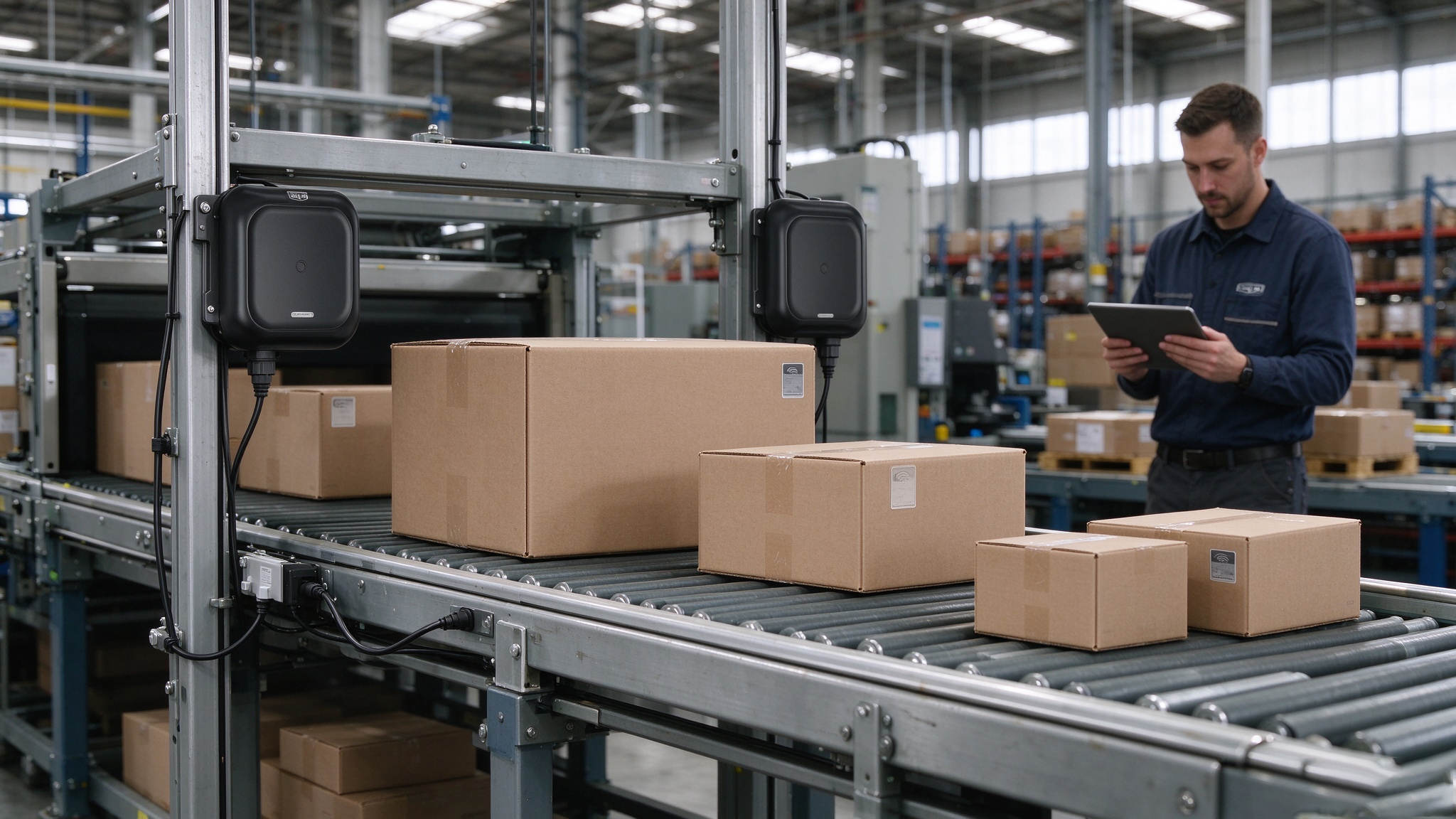 Fixed RFID readers can capture tag identifiers as goods move through receiving, sorting, or dispatch zones.
RFID is often described as a replacement for barcodes. That comparison is useful, but incomplete. A barcode scanner generally needs to see a printed code, while an RFID reader can detect compatible tags within its effective radio-frequency field. Depending on the tag type, reader configuration, materials nearby, and operating environment, the system may identify several items in a single read cycle.
For businesses, the important question is not simply whether RFID can read a tag. It is whether the system can reliably identify the right items at the right point in a real workflow.
What Is RFID Technology and How Does It Work?
RFID technology transfers identification data between an RFID tag and a RFID reader using radio-frequency signals. The reader captures the tag’s response and passes the resulting data to an application, database, or management platform.A typical system contains four elements:
- RFID tag: A small electronic device attached to or embedded in an item. It stores an identifier and, depending on the tag, may hold additional data.
- RFID reader: Equipment that communicates with compatible tags and receives their responses.
- Antenna: A component that transmits and receives radio-frequency signals. It may be integrated into the reader or connected separately.
- Software: The application layer that interprets tag reads and connects them to business records, inventory systems, access control, or other operations.
What happens during an RFID read?
1. The tag enters the reading zone
A tagged carton, product, tool, or asset moves into the reader’s effective radio-frequency field.2. The reader communicates with the tag
With passive RFID, the reader’s transmitted field powers the tag’s response. The tag returns its stored data through a radio signal, commonly using backscatter in UHF systems.3. The software processes the read
The application uses the captured identifier to look up an item record or trigger a configured business action, such as updating inventory or recording an asset movement.This sequence looks simple on paper. In an actual installation, read performance depends on antenna placement, tag orientation, the distance between reader and tag, and nearby materials. A tag attached to a cardboard box may behave differently from the same tag mounted on a metal tool or placed beside liquid-filled containers.
GS1’s RFID technical documentation explains the air-interface standards used for communication between compatible RFID devices. For UHF systems, the GS1 EPC UHF Gen2 standard defines how readers and tags communicate; supported frequencies depend on the applicable regional rules. See the GS1 EPC UHF Gen2 Air Interface Protocol.
Types of RFID Technology: LF, HF, and UHF
RFID is not a single radio technology. Different frequency bands serve different needs, and choosing the wrong one can create unnecessary cost or unreliable reads.| RFID type | Common frequency | Typical applications | Main consideration |
|---|---|---|---|
| Low Frequency (LF) | 125–134 kHz | Animal identification, some access-control systems | Short range and relatively low sensitivity to radio interference |
| High Frequency (HF) | 13.56 MHz | Contactless cards, ticketing, document identification, NFC applications | Often designed for close-range interaction |
| Ultra-High Frequency (UHF) | Approximately 860–960 MHz, depending on the system and region | Warehouse inventory, logistics, retail stock control, asset tracking | Supports longer-range and multi-tag reading, but tag placement and the environment matter |
Passive RFID vs. Active RFID
The power source is another important distinction.- Passive RFID: The tag has no battery dedicated to powering its normal communication. It draws energy from the reader’s field and responds to the reader.
- Active RFID: The tag has its own power source and transmitter, allowing it to send signals over longer distances.
- Battery-assisted passive RFID: A battery supports the tag’s circuitry or sensors, but communication may still use backscatter.
Where Is RFID Technology Used?
RFID is valuable when an organisation needs to connect a physical item with a digital record without scanning every label individually.- Warehousing and logistics: Identify tagged cartons, pallets, and reusable containers at receiving, dispatch, or transfer points.
- Retail: Support stock counts, item identification, and inventory visibility across storage and sales areas.
- Manufacturing: Associate tools, work-in-progress, components, or finished products with production records.
- Libraries: Manage tagged books, borrowing and returns, shelf inventory, and security workflows.
- Access control: Use compatible cards or credentials to identify authorised users.
- Asset and tool management: Record the movement of equipment and help identify missing or misplaced items.