
What is rfid and how is it used? RFID is a technology that uses radio waves to automatically identify tagged objects, while its practical uses include inventory tracking, retail, logistics, manufacturing, asset management, access control, and automated identification. An RFID tag stores an identifier, a reader captures it wirelessly, and software turns that reading into usable business data.
GS1 describes RFID as a generic term covering technologies that use radio waves to automatically capture an object’s unique identifier. A typical RFID tag combines a microchip with an antenna, while the reader converts the tag’s response into digital information for computer systems.
That definition sounds straightforward. The engineering is not always.
In an actual installation, the useful result is rarely just “the reader saw a tag.” The system has to determine which tag was read, where the reading happened, whether the event is relevant, and what the business application should do with it.
At Cykeo, this is the part of RFID deployment that tends to require the most practical attention. Reader placement, antenna direction, tag mounting, material, read-zone control, communication interfaces, and software logic all influence the final result.
Reader → RF field → Tag response → Reader → Digital data → Application
For passive UHF RFID, the tag receives energy from the reader’s RF field and responds with its stored information. GS1 identifies passive UHF RFID, also known as RAIN RFID, as operating in the 860–930 MHz range and notes applications including fast asset identification, inventory, and tracking. Depending on the environment, read ranges can reach up to 10 meters.
The important word is environment.
A ten-meter figure on a product sheet does not mean every tag will reliably read at ten meters after being attached to a liquid container, metal asset, densely packed carton, or folded garment. The tag and its mounting surface become part of the RF system.
GS1 reports typical LF read ranges of approximately 10–50 cm and HF ranges of roughly 10 cm–1 m, while passive UHF/RAIN RFID can reach considerably farther depending on conditions.
That is why asking for “the best RFID” without defining the application is usually the wrong starting point.
A library book, contactless card, livestock identifier, retail garment, warehouse pallet, and industrial tool can require very different RFID configurations.
A garment carrying a UHF RFID tag can be identified during receiving, moved into inventory records, counted with a handheld reader, located during store operations, or evaluated at a security gate.
Auburn University RFID Lab research on apparel has examined item-level RFID for inventory accuracy, out-of-stocks, cycle counting, and loss prevention. In its Dillard’s research, RFID provided information about what was stolen, when it was stolen, and where it was stolen.
The value is therefore broader than replacing a barcode scan. RFID can create a more continuous connection between a physical item and its digital record.
A practical deployment might look like:
Receiving → Tag identification → Inventory update → Storage → Picking → Shipping verification
The process can be automated further with fixed readers, antennas, conveyor portals, handheld readers, or RFID-enabled workstations.
Auburn research has also demonstrated the value of RFID-enabled inventory visibility in field environments. One study covered 13 stores over 23 weeks and reported approximately a 26% reduction in inventory record inaccuracy when RFID-enabled inventory adjustments were used.
That result should not be treated as a universal RFID performance guarantee. It came from a specific field experiment. What it does demonstrate is the type of operational problem RFID can address: the gap between what the system says is physically present and what is actually there.
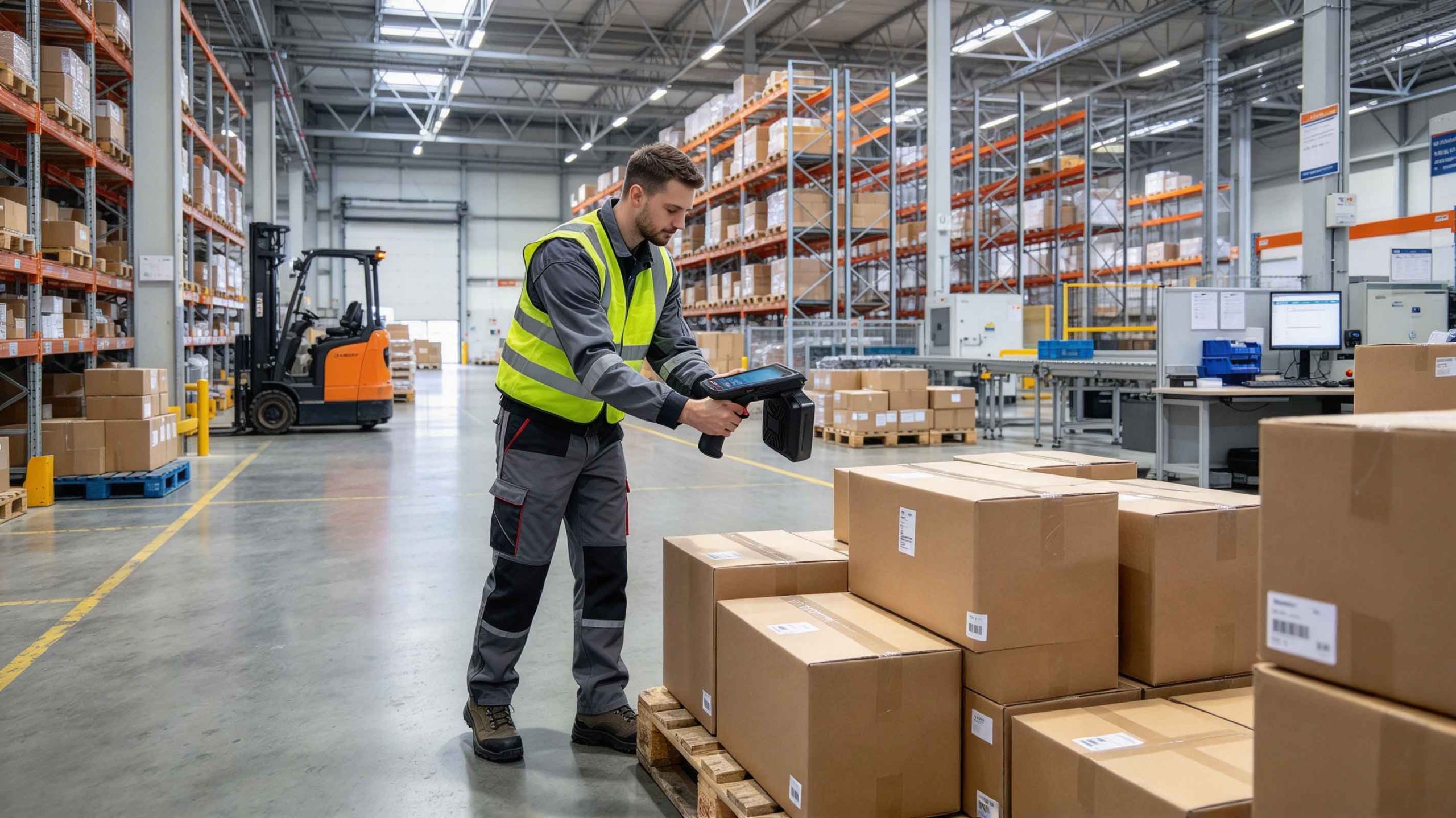 A UHF RFID reader identifies tagged cartons during a warehouse inventory
operation.
RFID is also used for:
It is “What physical event are we trying to capture?”
A warehouse may need a carton to be identified as it crosses a loading doorway. A retail store may need a garment to be distinguished from stationary merchandise near an exit. A library may need several books recognized while a visitor passes through a gate.
Those are three different read-zone problems, even though all three use RFID.
This is why reader sensitivity, antenna positioning, tag orientation, RF power, filtering, anti-collision behavior, communication interfaces, and application logic need to be considered together.
For passive UHF applications, the tag does not require its own battery. The reader’s RF field provides the energy needed for the tag to respond.
Tag construction matters more than it may appear. A label designed for corrugated cardboard is not automatically suitable for a steel tool, liquid container, or industrial machine. At Cykeo, tag selection is therefore normally considered together with the actual mounting surface and orientation rather than as an isolated purchasing decision.
GS1 describes RFID as a generic term covering technologies that use radio waves to automatically capture an object’s unique identifier. A typical RFID tag combines a microchip with an antenna, while the reader converts the tag’s response into digital information for computer systems.
That definition sounds straightforward. The engineering is not always.
In an actual installation, the useful result is rarely just “the reader saw a tag.” The system has to determine which tag was read, where the reading happened, whether the event is relevant, and what the business application should do with it.
At Cykeo, this is the part of RFID deployment that tends to require the most practical attention. Reader placement, antenna direction, tag mounting, material, read-zone control, communication interfaces, and software logic all influence the final result.
How RFID Works in Practice
An RFID system normally contains four working elements:- RFID tag — stores an identifier and communicates with the reader.
- RFID reader — sends and receives radio-frequency signals.
- Antenna — establishes the RF field between the reader and tags.
- Software or host system — interprets RFID events and connects them with business processes.
What Happens During an RFID Read?
A simplified UHF RFID transaction looks like this:Reader → RF field → Tag response → Reader → Digital data → Application
For passive UHF RFID, the tag receives energy from the reader’s RF field and responds with its stored information. GS1 identifies passive UHF RFID, also known as RAIN RFID, as operating in the 860–930 MHz range and notes applications including fast asset identification, inventory, and tracking. Depending on the environment, read ranges can reach up to 10 meters.
The important word is environment.
A ten-meter figure on a product sheet does not mean every tag will reliably read at ten meters after being attached to a liquid container, metal asset, densely packed carton, or folded garment. The tag and its mounting surface become part of the RF system.
RFID Frequency Determines How It Is Used
RFID is not one single radio technology. Frequency changes the behavior of the system and often influences the application.| RFID type | Typical frequency | Typical characteristics | Common uses |
|---|---|---|---|
| LF RFID | 125–134 kHz | Short range, relatively resistant to interference | Animal identification, physical access control |
| HF RFID | 13.56 MHz | Shorter-range identification | Ticketing, payment, documents, item tracking |
| UHF / RAIN RFID | 860–930 MHz | Faster, longer-range identification | Inventory, logistics, retail, asset tracking |
That is why asking for “the best RFID” without defining the application is usually the wrong starting point.
A library book, contactless card, livestock identifier, retail garment, warehouse pallet, and industrial tool can require very different RFID configurations.
What Is RFID Used For?
RFID is most valuable where an organization repeatedly needs to identify physical objects and connect those objects with digital records.RFID for Retail and Inventory
Retail is one of the strongest examples because merchandise can receive an electronic identity before reaching the sales floor.A garment carrying a UHF RFID tag can be identified during receiving, moved into inventory records, counted with a handheld reader, located during store operations, or evaluated at a security gate.
Auburn University RFID Lab research on apparel has examined item-level RFID for inventory accuracy, out-of-stocks, cycle counting, and loss prevention. In its Dillard’s research, RFID provided information about what was stolen, when it was stolen, and where it was stolen.
The value is therefore broader than replacing a barcode scan. RFID can create a more continuous connection between a physical item and its digital record.
RFID for Supply Chain and Logistics
In a warehouse, RFID can identify cartons, pallets, containers, or individual products at receiving and shipping points.A practical deployment might look like:
Receiving → Tag identification → Inventory update → Storage → Picking → Shipping verification
The process can be automated further with fixed readers, antennas, conveyor portals, handheld readers, or RFID-enabled workstations.
Auburn research has also demonstrated the value of RFID-enabled inventory visibility in field environments. One study covered 13 stores over 23 weeks and reported approximately a 26% reduction in inventory record inaccuracy when RFID-enabled inventory adjustments were used.
That result should not be treated as a universal RFID performance guarantee. It came from a specific field experiment. What it does demonstrate is the type of operational problem RFID can address: the gap between what the system says is physically present and what is actually there.
operation.
RFID Is Used Beyond Inventory
Inventory tracking is only one part of the picture.RFID is also used for:
- Asset tracking: identifying tools, equipment, containers, and reusable assets.
- Manufacturing: monitoring work-in-process materials and production movements.
- Libraries: identifying books and automating circulation-related processes.
- Laundry and linen: tracking reusable garments and textiles.
- Access control: identifying RFID credentials or controlling tagged-object movement.
- Retail security: detecting and evaluating RFID-tagged merchandise at store exits.
- Healthcare: identifying equipment, supplies, and other appropriately tagged assets.
- Document management: identifying physical records and controlled materials.
- Event and transportation systems: using HF/NFC-based RFID technologies for ticketing and related identification.
A Practical Cykeo Perspective
When we evaluate an RFID application at Cykeo, the first useful question is often not “How many tags per second can the reader process?”It is “What physical event are we trying to capture?”
A warehouse may need a carton to be identified as it crosses a loading doorway. A retail store may need a garment to be distinguished from stationary merchandise near an exit. A library may need several books recognized while a visitor passes through a gate.
Those are three different read-zone problems, even though all three use RFID.
This is why reader sensitivity, antenna positioning, tag orientation, RF power, filtering, anti-collision behavior, communication interfaces, and application logic need to be considered together.
RFID Tags, Readers, and Antennas: What Each Part Does
An RFID system only works well when the tag, reader, antenna, and application are treated as one system.RFID Tags
An RFID tag normally contains an integrated circuit and antenna. The chip provides the electronic identity and, depending on the tag type and memory configuration, can hold additional information.For passive UHF applications, the tag does not require its own battery. The reader’s RF field provides the energy needed for the tag to respond.
Tag construction matters more than it may appear. A label designed for corrugated cardboard is not automatically suitable for a steel tool, liquid container, or industrial machine. At Cykeo, tag selection is therefore normally considered together with the actual mounting surface and orientation rather than as an isolated purchasing decision.