
What is rfid access control? RFID access control is a security system that uses RFID readers, electronic tags, and controlled detection zones to identify tagged items or authorized RFID credentials and trigger an action when defined conditions are met. In retail, RFID access control can be used as a security gate to identify tagged merchandise moving through a store entrance or exit.
Unlike a conventional barrier that simply detects an object, an RFID security gate can work with the identity stored on the RFID tag. This makes the system useful where the business needs to distinguish merchandise leaving a defined area from tags that remain inside the store.
For a retail clothing store, for example, the objective is not simply to detect that something has crossed the doorway. The system needs to determine whether an RFID-tagged garment is actually passing through the security zone and whether that tag should generate an alarm.
That distinction is important in real installations.
GS1’s current EPC Gen2 UHF RFID standard is version 3.0.1, updated on February 26, 2026, and specifies the air-interface protocol for communications in the 860–930 MHz range.
This is more than a standards label. In a busy retail doorway, multiple garments can pass through the detection area at nearly the same time. The reader therefore needs a protocol and RF architecture capable of handling multiple tags rather than treating every tag as an isolated event.
Instead of continuously treating every RFID response in the surrounding area as a possible security event, the infrared sensing mechanism can provide a physical passage trigger. The RFID system can then evaluate tags associated with that passage event.
This approach is particularly useful in stores where merchandise may be displayed close to the entrance. Static RFID tags around the doorway should not automatically be interpreted as merchandise leaving the premises.
The Cykeo design therefore combines RFID identification with intelligent tag-state judgment and filtering of surrounding static tags. The goal is a cleaner decision at the doorway, rather than simply increasing reader sensitivity.
Research from Auburn University’s RFID Lab has examined RFID specifically in apparel environments, including inventory accuracy, cycle counting, loss prevention, and item-level identification. Its Dillard’s field research found that RFID provided retailers with information about what was stolen, when it was stolen, and where it was stolen, demonstrating why item-level identification can support loss-prevention operations beyond simply sounding an alarm.
The broader retail-loss problem is substantial. The National Retail Federation reported that U.S. retail shrink reached $94.5 billion in 2021, equivalent to an average shrink rate of 1.44% in its survey. Apparel was among the product categories identified as particularly affected.
More recent NRF research also shows that the problem continues to evolve. Its 2026 study reported an 8.1% decrease in retail merchandise theft in 2025 compared with 2024, while other forms of external theft, fraud, and scams increased.
These figures do not mean an RFID gate alone can eliminate retail shrink. They do show why retailers continue to combine identification technology with broader loss-prevention processes.
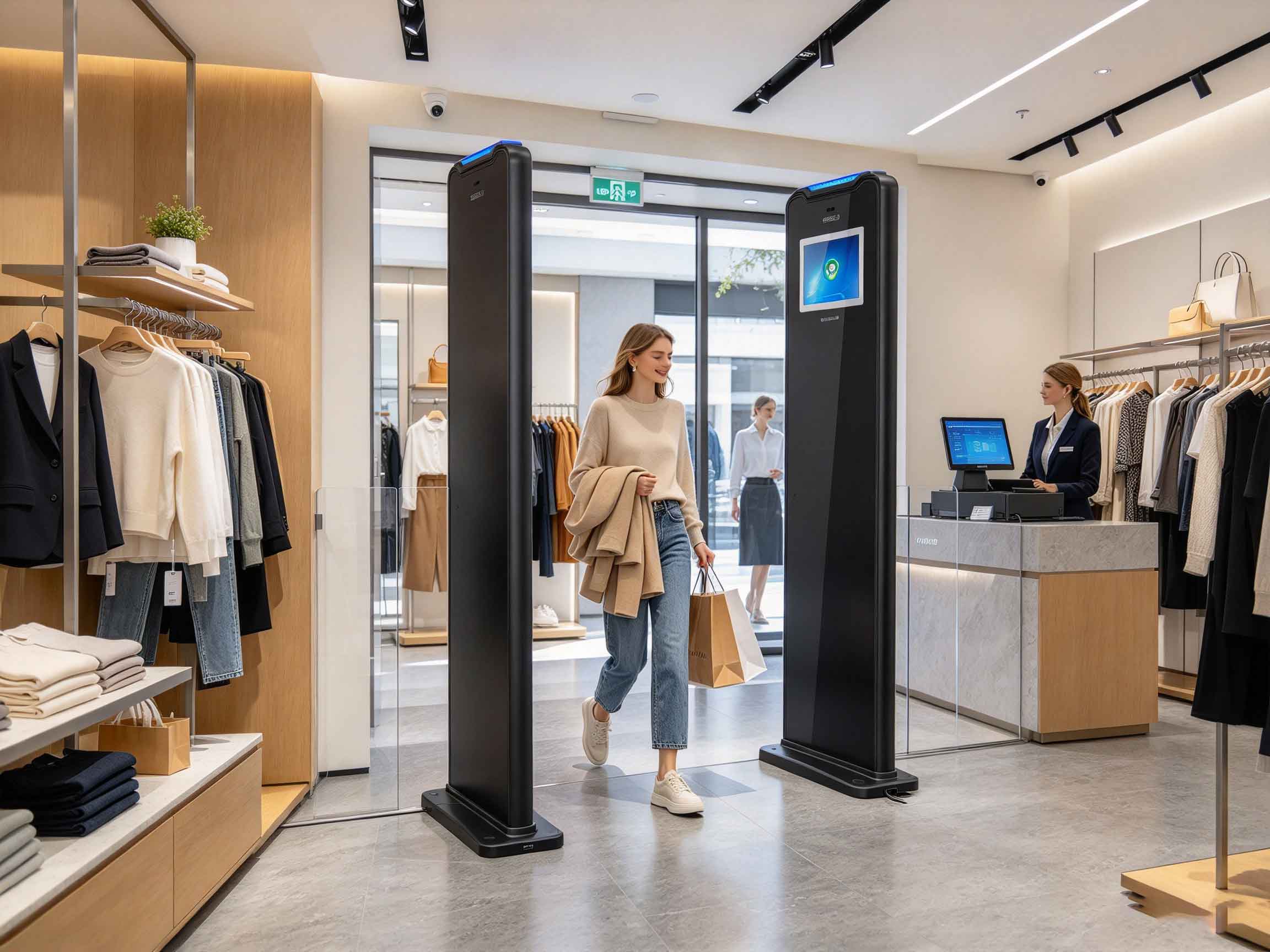 An RFID security gate identifies tagged apparel as customers pass through a
controlled retail entrance and exit zone.
One of the supplied mechanical specifications is especially relevant to installation planning: the RFID security gates can be arranged with a wider spacing, with a maximum distance of 2.4 m according to the product specification.
That figure should be treated as an installation parameter rather than a universal RFID reading guarantee. Actual performance depends on the tag, reader configuration, antenna arrangement, merchandise density, doorway construction, and surrounding RF environment.
That difference becomes useful when a retailer has hundreds or thousands of tagged products distributed around the store.
A Cykeo RFID security gate is designed to evaluate RFID tag status, rather than simply reacting to every RFID signal in the vicinity. The intelligent filtering function can automatically exclude surrounding static tags while focusing on tags associated with movement through the gate.
This is particularly important at the edge of a sales floor. A rack of clothing may be only a short distance from the entrance. If the system simply increased RF sensitivity, it could create more unwanted reads. In practice, controlling which tag responses constitute an event is often more important than pursuing maximum reading distance.
A customer walks toward the exit. Several tags remain stationary on nearby clothing racks. The infrared sensor detects the passage, while the RFID reader captures tag responses in the security zone. The system then evaluates the tag movement and status rather than treating every nearby tag as an alarm condition.
This is where RFID access control becomes an application-specific system instead of merely an RFID reader placed beside a door.
The product is designed to support:
Unlike a conventional barrier that simply detects an object, an RFID security gate can work with the identity stored on the RFID tag. This makes the system useful where the business needs to distinguish merchandise leaving a defined area from tags that remain inside the store.
For a retail clothing store, for example, the objective is not simply to detect that something has crossed the doorway. The system needs to determine whether an RFID-tagged garment is actually passing through the security zone and whether that tag should generate an alarm.
That distinction is important in real installations.
How RFID Access Control Works in Retail
A typical RFID access control system combines several functions in one security point:- RFID antennas and readers for tag identification
- RFID tags attached to merchandise
- Infrared sensors for passage triggering
- Intelligent algorithms for tag-state evaluation
- Audible and visual alarms
- Ethernet communication
- Optional Wi-Fi or 4G communication
- People-counting functionality
- Online or offline EAS alarm modes
GS1’s current EPC Gen2 UHF RFID standard is version 3.0.1, updated on February 26, 2026, and specifies the air-interface protocol for communications in the 860–930 MHz range.
This is more than a standards label. In a busy retail doorway, multiple garments can pass through the detection area at nearly the same time. The reader therefore needs a protocol and RF architecture capable of handling multiple tags rather than treating every tag as an isolated event.
Why Infrared Triggering Matters
One practical detail in an RFID security gate is the infrared trigger.Instead of continuously treating every RFID response in the surrounding area as a possible security event, the infrared sensing mechanism can provide a physical passage trigger. The RFID system can then evaluate tags associated with that passage event.
This approach is particularly useful in stores where merchandise may be displayed close to the entrance. Static RFID tags around the doorway should not automatically be interpreted as merchandise leaving the premises.
The Cykeo design therefore combines RFID identification with intelligent tag-state judgment and filtering of surrounding static tags. The goal is a cleaner decision at the doorway, rather than simply increasing reader sensitivity.
RFID Access Control for Apparel and Retail Loss Prevention
Retail is one of the clearest applications for item-level RFID because each garment can carry its own electronic identity.Research from Auburn University’s RFID Lab has examined RFID specifically in apparel environments, including inventory accuracy, cycle counting, loss prevention, and item-level identification. Its Dillard’s field research found that RFID provided retailers with information about what was stolen, when it was stolen, and where it was stolen, demonstrating why item-level identification can support loss-prevention operations beyond simply sounding an alarm.
The broader retail-loss problem is substantial. The National Retail Federation reported that U.S. retail shrink reached $94.5 billion in 2021, equivalent to an average shrink rate of 1.44% in its survey. Apparel was among the product categories identified as particularly affected.
More recent NRF research also shows that the problem continues to evolve. Its 2026 study reported an 8.1% decrease in retail merchandise theft in 2025 compared with 2024, while other forms of external theft, fraud, and scams increased.
These figures do not mean an RFID gate alone can eliminate retail shrink. They do show why retailers continue to combine identification technology with broader loss-prevention processes.
controlled retail entrance and exit zone.
Key RFID Access Control Features
For a store or library installation, the physical design of the security gate matters almost as much as the RFID electronics.| Feature | Practical function |
|---|---|
| Multi-tag reading | Identifies multiple RFID tags moving through the zone |
| Specially designed antenna | Creates a controlled detection area with fewer blind spots |
| Infrared triggering | Detects a physical passage event for RFID evaluation |
| Intelligent tag filtering | Helps distinguish moving merchandise from surrounding static tags |
| Sound and light alarm | Provides immediate local notification |
| Online EAS mode | Supports network-connected alarm management |
| Offline EAS mode | Allows local alarm operation without continuous network dependence |
| Ethernet | Provides wired communication with the host system |
| Wi-Fi / 4G expansion | Supports alternative communication architectures |
| People counting | Records entry and exit traffic |
| External display | Can show passing item information and quantities |
That figure should be treated as an installation parameter rather than a universal RFID reading guarantee. Actual performance depends on the tag, reader configuration, antenna arrangement, merchandise density, doorway construction, and surrounding RF environment.
How RFID Access Control Differs From Conventional EAS
Traditional electronic article surveillance (EAS) is primarily designed to detect whether a protected item crosses a security boundary. RFID access control can go further because the RFID tag can provide an electronic identity that the reader evaluates.That difference becomes useful when a retailer has hundreds or thousands of tagged products distributed around the store.
A Cykeo RFID security gate is designed to evaluate RFID tag status, rather than simply reacting to every RFID signal in the vicinity. The intelligent filtering function can automatically exclude surrounding static tags while focusing on tags associated with movement through the gate.
This is particularly important at the edge of a sales floor. A rack of clothing may be only a short distance from the entrance. If the system simply increased RF sensitivity, it could create more unwanted reads. In practice, controlling which tag responses constitute an event is often more important than pursuing maximum reading distance.
RFID Tag Filtering at the Store Entrance
Consider a garment store with RFID-tagged jackets hanging close to the doorway.A customer walks toward the exit. Several tags remain stationary on nearby clothing racks. The infrared sensor detects the passage, while the RFID reader captures tag responses in the security zone. The system then evaluates the tag movement and status rather than treating every nearby tag as an alarm condition.
This is where RFID access control becomes an application-specific system instead of merely an RFID reader placed beside a door.
The product is designed to support:
- Multi-tag identification during a passage event
- Extremely low missed-reading and false-reading performance
- Accurate antenna coverage
- Filtering of static surrounding RFID tags
- Real-time tag-state judgment
- Integrated sound and light alarms