
What is an rfid device? An RFID device is electronic hardware that uses radio-frequency communication to identify, read, and sometimes write RFID tags. In UHF RFID systems, the device normally works with passive tags, antennas, and software to capture item-level identification data without requiring direct line of sight.
For business applications, the phrase RFID device usually refers to equipment such as a UHF RFID reader, handheld reader, fixed reader, desktop reader, or RFID reader module. The exact hardware depends on where the identification task takes place.
GS1 identifies passive UHF RFID as RAIN RFID and states that these systems use the 860–930 MHz range and comply with GS1/EPC Gen2 and ISO/IEC 18000-63. GS1 also identifies fast asset identification, inventory, and tracking as major UHF RFID applications.
Typical applications include:
GS1 notes that RAIN RFID does not require the same line-of-sight interaction as barcode scanning and can support rapid inventory collection.
Depending on the application, it may be:
The reader does not operate alone. In a conventional UHF installation, the reader, antenna, RFID tag, communication interface, and application software form one working system.
The data structure can include an EPC and, depending on the tag and application, additional user memory. GS1 states that a typical RAIN RFID tag carries no more than about 8 KB of data, while simple license-plate style tags may use a 96-bit or 128-bit identifier.
That distinction matters when specifying tags. Many inventory applications do not need large amounts of information stored directly on the tag. A unique identifier can be enough for the software to retrieve the detailed product record.
The important point is that the RFID device does not magically “track” an object by itself. It creates an identification event. The application determines what that event means—received goods, an inventory count, a tool return, or another business transaction.
GS1 describes RAIN RFID as being designed for fast asset identification, inventory, and tracking, with read ranges that can reach up to 10 meters depending on the environment.
That number should not be treated as a guaranteed operating distance.
In an actual warehouse, tag orientation, antenna position, reader power, packaging, metal structures, liquids, RF interference, and tag density can change the result. In field testing, the shape of the reading zone is often more important than the maximum range printed on a specification sheet.
A well-controlled 3-meter reading zone can be more useful than an uncontrolled 10-meter zone if the application needs to identify only the cartons passing through a doorway.
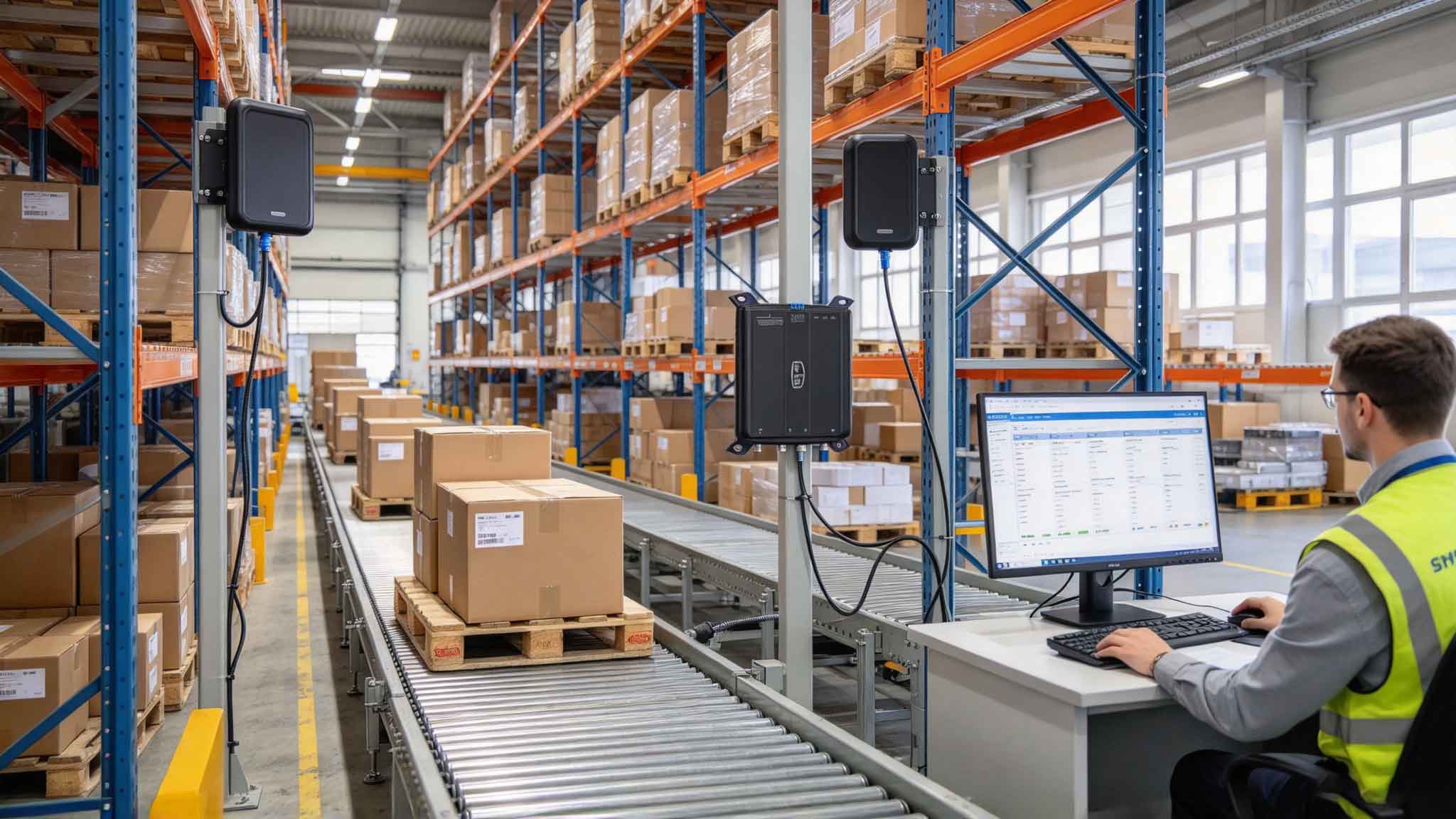 A fixed UHF RFID device identifies tagged cartons as they pass through a controlled warehouse reading zone.
GS1’s current EPC Gen2 standard identifies the UHF RFID air-interface technology as operating in the 860–960 MHz range, while regional implementations determine the actual permitted frequency and power conditions. GS1’s current standard page records Release 3.0.1 as ratified in February 2026.
For equipment buyers, standards compatibility is therefore more useful than simply comparing a reader’s advertised read distance.
A UHF RFID device should be evaluated according to:
In a warehouse, for example, the reader can be installed beside a receiving or shipping passage. Tagged cartons pass through the defined RF zone, and the system records the tag IDs detected at that point.
The same principle works on a smaller scale.
A technician can carry a handheld UHF RFID reader along a tool shelf. A retailer can use a reader to count tagged apparel. A textile facility can identify reusable linen as it moves between processing stages.
The hardware changes. The underlying task does not: turn a physical tagged object into machine-readable identification data.
Typical deployments include:
This is where installation experience matters. Moving an antenna only a small distance can change the shape of the RF field around a doorway or conveyor.
For business applications, the phrase RFID device usually refers to equipment such as a UHF RFID reader, handheld reader, fixed reader, desktop reader, or RFID reader module. The exact hardware depends on where the identification task takes place.
GS1 identifies passive UHF RFID as RAIN RFID and states that these systems use the 860–930 MHz range and comply with GS1/EPC Gen2 and ISO/IEC 18000-63. GS1 also identifies fast asset identification, inventory, and tracking as major UHF RFID applications.
What Is a UHF RFID Device Used For?
A UHF RFID device is mainly used to identify tagged objects quickly within a defined RF reading area.Typical applications include:
- Warehouse inventory
- Asset identification
- Logistics and shipment handling
- Retail item tracking
- Apparel management
- Tool management
- Library inventory
- Textile and laundry management
- Production-line identification
- Tag registration and rewriting
GS1 notes that RAIN RFID does not require the same line-of-sight interaction as barcode scanning and can support rapid inventory collection.
UHF RFID Device Components
UHF RFID Reader
The reader is the active electronic component that communicates with the RFID tag.Depending on the application, it may be:
| Device type | Typical application |
|---|---|
| Fixed UHF RFID reader | Warehouse portals, conveyors, production lines |
| Handheld UHF reader | Shelf inventory, asset searching, field operations |
| Desktop RFID reader | Tag registration and controlled read/write |
| OEM RFID module | Embedded RFID equipment and customized systems |
UHF RFID Tag
The passive UHF RFID tag contains an RFID chip and RFID antenna. The tag responds when it receives sufficient RF energy from the reader.The data structure can include an EPC and, depending on the tag and application, additional user memory. GS1 states that a typical RAIN RFID tag carries no more than about 8 KB of data, while simple license-plate style tags may use a 96-bit or 128-bit identifier.
That distinction matters when specifying tags. Many inventory applications do not need large amounts of information stored directly on the tag. A unique identifier can be enough for the software to retrieve the detailed product record.
How Does a UHF RFID Device Work?
The operating sequence is straightforward:- The UHF RFID reader generates an RF field.
- A compatible passive tag enters the reading area.
- The tag responds through backscatter communication.
- The reader receives the tag response.
- The reader processes the identification data.
- Software uses the data as an inventory, tracking, or identification event.
The important point is that the RFID device does not magically “track” an object by itself. It creates an identification event. The application determines what that event means—received goods, an inventory count, a tool return, or another business transaction.
Why UHF RFID Is Used for Fast Identification
UHF RFID is particularly useful when many tagged objects must be identified within a short period.GS1 describes RAIN RFID as being designed for fast asset identification, inventory, and tracking, with read ranges that can reach up to 10 meters depending on the environment.
That number should not be treated as a guaranteed operating distance.
In an actual warehouse, tag orientation, antenna position, reader power, packaging, metal structures, liquids, RF interference, and tag density can change the result. In field testing, the shape of the reading zone is often more important than the maximum range printed on a specification sheet.
A well-controlled 3-meter reading zone can be more useful than an uncontrolled 10-meter zone if the application needs to identify only the cartons passing through a doorway.
UHF RFID Device and RFID Standards
UHF RFID equipment used for supply-chain applications commonly follows the GS1/EPC Gen2 ecosystem.GS1’s current EPC Gen2 standard identifies the UHF RFID air-interface technology as operating in the 860–960 MHz range, while regional implementations determine the actual permitted frequency and power conditions. GS1’s current standard page records Release 3.0.1 as ratified in February 2026.
For equipment buyers, standards compatibility is therefore more useful than simply comparing a reader’s advertised read distance.
A UHF RFID device should be evaluated according to:
- Supported RFID protocol
- Regional frequency requirements
- Reader output power
- Antenna configuration
- Tag compatibility
- Multi-tag performance
- Communication interface
- Software and SDK support
- Required reading-zone size
What Is an RFID Device Used for in Real Applications?
A UHF RFID device becomes useful when physical items need to be identified repeatedly without stopping the workflow.In a warehouse, for example, the reader can be installed beside a receiving or shipping passage. Tagged cartons pass through the defined RF zone, and the system records the tag IDs detected at that point.
The same principle works on a smaller scale.
A technician can carry a handheld UHF RFID reader along a tool shelf. A retailer can use a reader to count tagged apparel. A textile facility can identify reusable linen as it moves between processing stages.
The hardware changes. The underlying task does not: turn a physical tagged object into machine-readable identification data.
UHF RFID Device Types and Their Working Environments
Fixed UHF RFID Devices
Fixed readers are permanently installed at a defined location.Typical deployments include:
- Warehouse entrances and exits
- Conveyor systems
- Production lines
- Sorting stations
- Asset checkpoints
- Retail back rooms
This is where installation experience matters. Moving an antenna only a small distance can change the shape of the RF field around a doorway or conveyor.