
Why Tool Management Becomes Difficult
A workshop with 20 tools is easy to manage.A factory with 500 tools is different. Add several maintenance teams, multiple work areas, shared equipment, and tools that move every day, and keeping accurate records becomes a real job on its own.
Someone has to record what was taken, who took it, when it should come back, and whether it was actually returned.
That is where RFID tool management becomes useful.
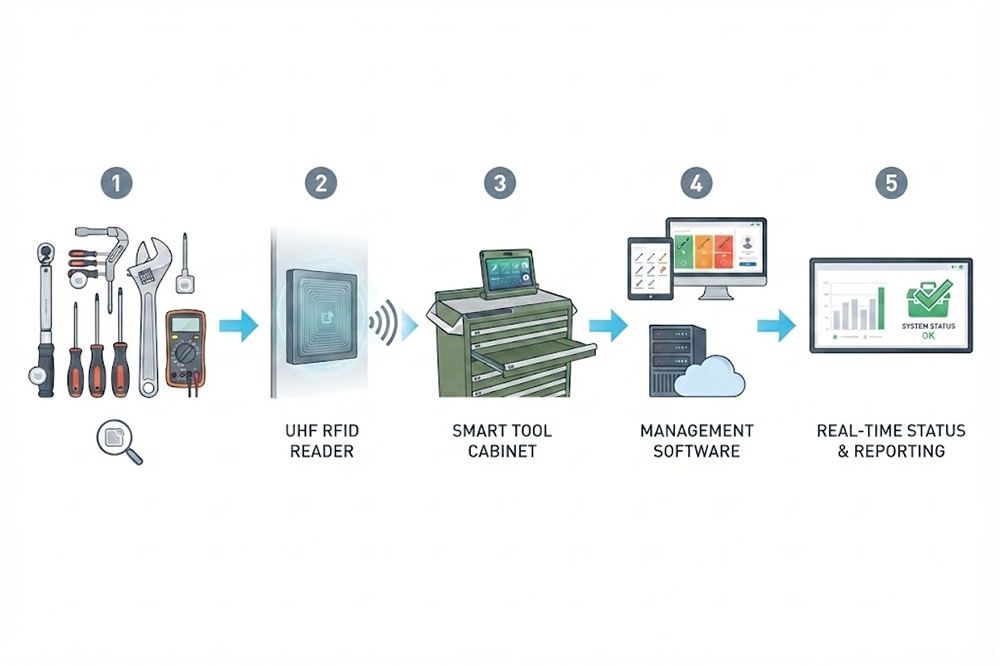
Instead of relying entirely on paper records, spreadsheets, or individual barcode scans, RFID gives each tool a digital identity. RFID readers can then identify tagged tools and send the information to management software.
The result is a more connected way to control tools from storage to actual use.
For a broader overview of RFID readers, tags, cabinets, carts, and other equipment, see our guide to RFID Tools & Devices.
What Is RFID Tool Management?
RFID tool management is a system that uses radio frequency identification technology to identify, track, and manage physical tools.A typical system includes:
- RFID tags
- RFID readers
- RFID antennas
- Tool cabinets or carts
- User identification
- Management software
- Database or ERP integration
Tag the tool → Store the tool → Identify the user → Track movement → Update inventory
The important part is that RFID connects the physical tool with digital information.
For example, instead of simply seeing:
Torque Wrench #025
the system can potentially show:
Torque Wrench #025 — Checked Out — Technician 018 — 10:24 AM
That extra information is what makes RFID useful for tool control.
How Does an RFID Tool Management System Work?
The first step is to assign an RFID tag to every tool that needs to be tracked.The tag contains a unique identification number.
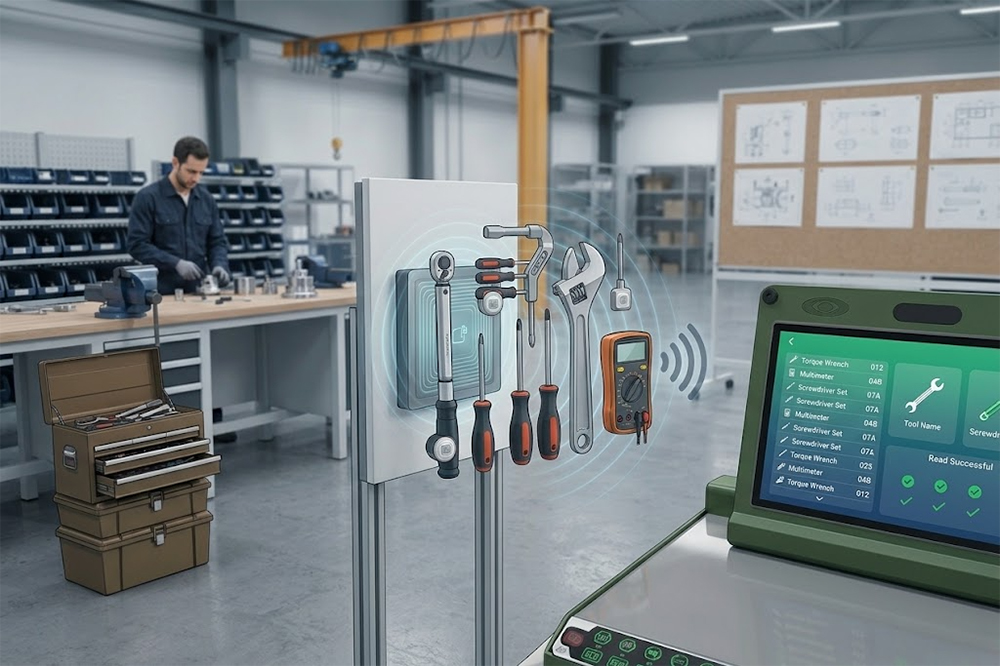
When a tool enters an RFID reading area, an RFID reader detects the tag. The reader sends the identification information to the software, which matches it with the corresponding tool record.
A basic architecture looks like this:
RFID Tag → Reader → Antenna → Software → Database
For a smart tool cabinet, the process can become more automated.
A technician identifies themselves, accesses the cabinet, removes a tool, and the system records the transaction.
When the tool comes back, the RFID system can update its status again.
This means the tool record changes as the tool moves instead of waiting for someone to update a spreadsheet later.
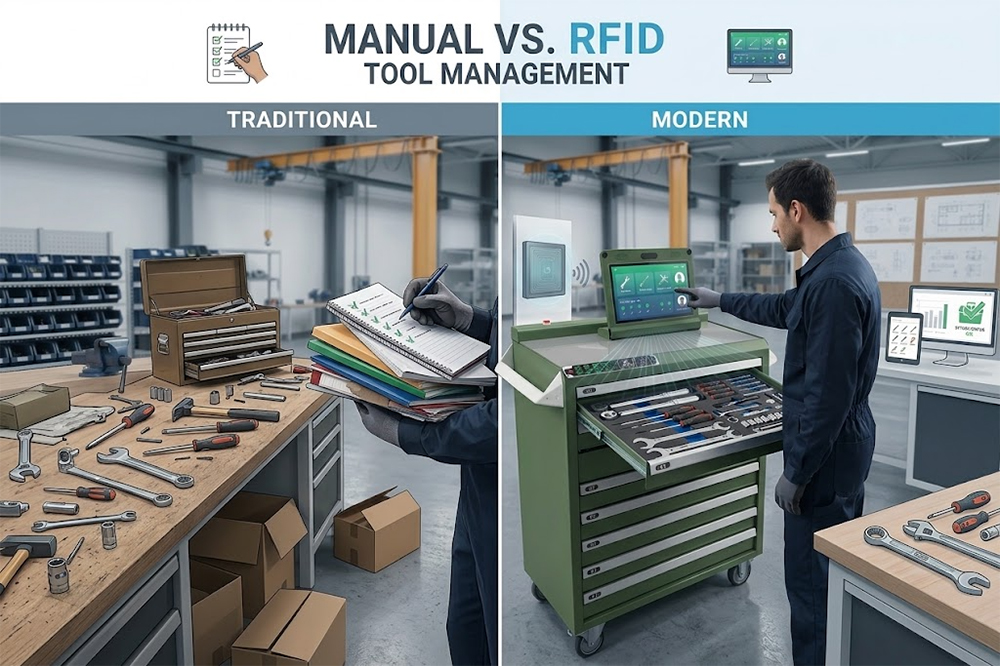
RFID Tool Management vs. Manual Tool Control
Manual management is still common, especially in smaller workshops.A typical process might look like this:
- Employee asks for a tool.
- Manager records the tool number.
- Employee signs a paper sheet.
- Tool is used.
- Employee returns it.
- Someone updates the record.
With RFID, many of these steps can be automated.
| Manual Tool Management | RFID Tool Management |
|---|---|
| Paper records | Digital records |
| Manual identification | Automatic identification |
| Individual scanning | Multiple-tag reading |
| Manual inventory | Faster inventory checks |
| Limited history | Tool movement history |
| Difficult accountability | User-based tracking |
What Can RFID Tool Management Track?
A good system can track more than simple tool location.Depending on the software and hardware configuration, it can manage:
Tool Identity
Every tagged tool has a unique digital ID.Tool Status
The system can show whether the tool is:- Available
- Checked out
- Returned
- Missing
- Under maintenance
- Under calibration
User Information
The system can associate a tool transaction with an employee, technician, department, or authorized user.Check-In and Check-Out
Tool movements can be recorded when equipment leaves or returns to controlled storage.Inventory
Managers can quickly check which tools are currently available.Usage History
Historical data can show how often a tool is used and who has used it.This information becomes increasingly useful as the tool inventory grows.
RFID Tool Cabinets for Controlled Storage
For organizations where tools are normally stored in one location, an RFID tool cabinet can be one of the most practical ways to implement RFID tool management.The cabinet combines physical storage with RFID identification.
Instead of opening a normal cabinet and manually checking the contents, users can interact with an intelligent cabinet designed to identify tagged tools and record transactions.
Depending on the configuration, RFID cabinets may support:
- User authentication
- Automatic inventory
- Tool check-out
- Tool return
- Access control
- Tool status management
- Alerts
- Software integration
Explore RFID Tool Cabinet Solutions
RFID Tool Tracking Beyond the Cabinet
An RFID tool management system does not have to stop at the cabinet.Tools often leave the storage area.
A technician may take a set of tools to a production line, aircraft, machine room, or construction site.
This is where other RFID devices can complement the cabinet.
Handheld RFID Readers
Handheld readers can be used for mobile inventory checks and tool verification.RFID Tool Carts
Mobile carts allow technicians to transport tools while keeping RFID-based management close to the work area.RFID Tool Bags
For field technicians, RFID-enabled bags or backpacks can provide a portable tool management point.This creates a broader system:
RFID Cabinet → RFID Tool Cart → Handheld Reader → Field Operation
The exact combination depends on the workflow.
Why RFID Tool Management Helps Reduce Missing Tools
One of the most common problems in shared tool environments is not necessarily theft.Sometimes a tool is simply somewhere else.
It may be:
- On another production line
- With another technician
- Inside a maintenance vehicle
- Left at a work station
- Waiting for calibration
- Returned to the wrong location
RFID provides a clearer record of tool movement.
If a system records that Tool #102 was checked out by Technician 018 at 10:20 AM, the maintenance manager has a starting point.
This is much more useful than discovering three days later that the tool is missing from the cabinet.
RFID Tool Inventory Management
Inventory checking is another area where RFID can save time.Imagine a tool room containing 800 tagged tools.
A manual inventory requires someone to inspect and count the tools.
With an RFID-enabled system, readers can identify multiple tags within the designed reading area.
This makes periodic inventory checks much faster.
The exact performance depends on:
- RFID tag type
- Tool material
- Cabinet design
- Antenna placement
- Reader configuration
- Tag orientation
- RF interference