
RFID Tool Cabinet for Tool Risk Management: Identify Problems Before They Escalate
A missing screwdriver and an unavailable torque wrench may both appear as tool management problems, but the consequences can be very different. One may cause a short delay in a routine maintenance task. The other could interrupt a production line, delay a quality inspection, or leave a critical job waiting for equipment.Industrial companies do not need the same level of control for every tool. They need to understand which tools create the greatest operational, financial, quality, or safety risks and decide how those risks should be managed.
An RFID tool cabinet can support this work by improving tool identification, recording checkout and return events, supporting configured access rules, and making selected tool statuses easier to review. When these functions are connected to a clear risk management process, teams can respond more consistently to missing tools, overdue returns, restricted equipment, and recurring shortages.
The cabinet is not a complete risk management system by itself. Its value depends on how the company classifies tools, defines control requirements, handles exceptions, and uses the information collected.
What Is Tool Risk Management?
Tool risk management is the process of identifying problems that could arise from storing, issuing, using, maintaining, or losing industrial tools, then applying controls appropriate to their potential consequences.The risks vary by workplace. A general-purpose wrench may mainly create a replacement cost if it goes missing. A calibrated measuring instrument may introduce quality concerns if its status is uncertain. A specialized maintenance tool may cause production delays if it cannot be located when needed.
A practical risk management process usually includes identifying tools and possible failure scenarios, estimating their likelihood and impact, selecting controls, assigning responsibility, and reviewing whether those controls are working.
An RFID tool cabinet can contribute to several parts of this process. It can help establish which tools are registered, record supported transactions, associate events with users, and provide information about recorded availability or status.
These records can help teams investigate risk events and identify patterns. For example, repeated overdue returns from one department may indicate a workflow problem, while frequent requests for an unavailable tool may reveal a shortage or allocation issue.
The important point is that risk management starts with understanding the consequences of a problem. RFID provides useful information and control options, but people still need to assess the risks and decide what action is appropriate.
Which Tool Risks Should Companies Consider?
Tool loss and unexplained inventory differences
Tools may disappear gradually rather than in one obvious incident. An item is borrowed without a complete transaction, returned to the wrong storage area, or moved to another department without updating its record.Over time, the digital register and physical inventory no longer match.
An RFID-enabled cabinet can support inventory verification and record tool checkout and return events. When a discrepancy appears, supervisors can review the available transaction history and investigate whether the issue involves an incomplete return, an incorrect record, or a genuinely missing item.
This does not guarantee that every loss will be prevented. The effectiveness depends on tag readability, cabinet design, transaction rules, and whether tools are required to pass through the controlled workflow.
Production delays caused by unavailable tools
Some tools are inexpensive but operationally critical. A particular fixture, service tool, or specialized instrument may be required for one specific maintenance procedure.If that item is missing, being repaired, or already allocated to another team, the cost of the delay may exceed the replacement value of the tool.
An RFID tool cabinet can help teams review recorded availability, outstanding checkouts, and recurring demand. Combined with work-order planning, these records can reveal which tools deserve closer availability monitoring or a backup plan.
For more detailed guidance, companies can also review RFID tool downtime management and RFID tool demand planning.
Unauthorized access or use
Some tools are expensive, sensitive, specialized, or subject to internal restrictions. Uncontrolled access can increase the risk of loss, misuse, or use by personnel who have not received the required training.A compatible RFID cabinet system may support user authentication, permissions, and transaction records. These features can help a company apply different access rules to different tool categories.
However, a recorded user identity does not prove that the tool was used correctly after checkout. Where misuse could have serious consequences, additional safeguards, supervision, training, and work procedures may be necessary.
Tools used in unsuitable condition
A tool can be physically available but not ready for use. It may be damaged, awaiting repair, overdue for inspection, or subject to a restriction that has not been reflected in the cabinet’s current status.This creates a different kind of risk from ordinary tool loss. The concern is not simply whether the tool can be found, but whether it should be issued.
A tool management platform can link tools to maintenance or inspection information when the relevant data is available. Depending on the system, it may display warnings, flag restricted items, or enforce configured checkout rules.
The company must define the status categories and ensure that inspection or maintenance information remains accurate.
Poor visibility across departments
A tool may be available somewhere in a factory but remain unavailable to the team that needs it. Different departments may maintain separate registers, use different naming conventions, or follow inconsistent transfer procedures.This makes it difficult to understand the overall exposure created by shared equipment.
A coordinated RFID tool management system can help standardize tool identities and record movements between cabinets or locations where the required functionality is supported. This gives managers a better basis for reviewing shared resources and deciding where stronger controls are needed.
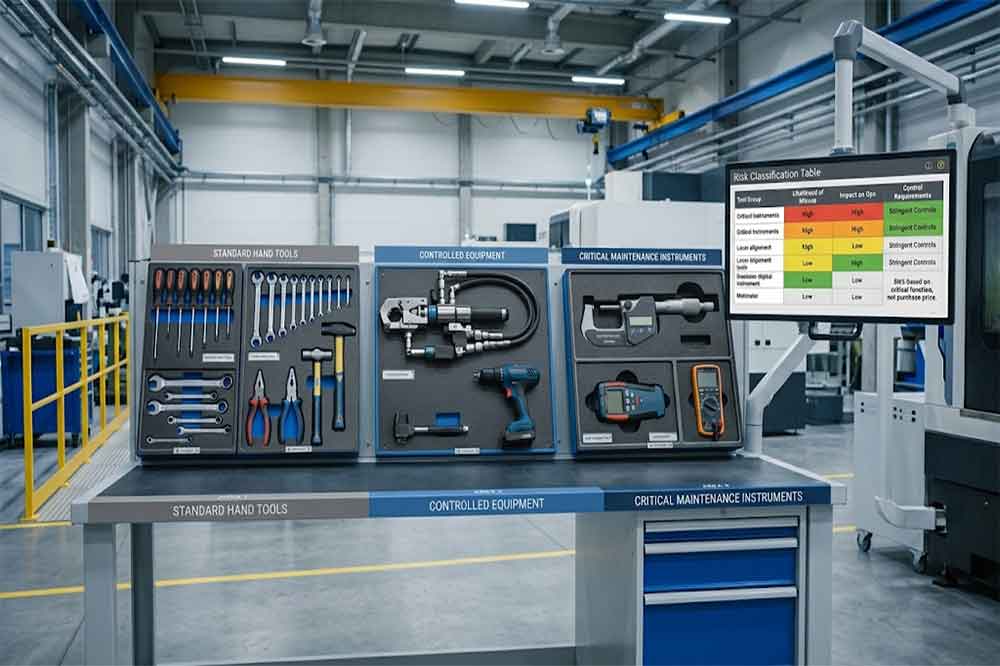
Classify Tools According to Risk
One of the most useful steps is to stop treating all tools as equally important.A simple classification process can group tools according to factors such as replacement value, operational criticality, inspection requirements, access restrictions, loss history, and the consequences of incorrect use.