

GainzAlgo
New member
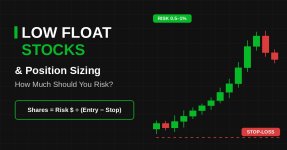
Few corners of the market move as fast as low float stocks . A ticker can jump 80% before lunch and then give most of it back by closing. That speed attracts traders. However, it also wipes out accounts that ignore one simple question: how much should you risk on each trade?
After two decades of watching traders handle these names, one pattern stands out. The ones who last are rarely the best stock pickers. Instead, they are the ones who size their positions with discipline. This guide explains how to do that, step by step.
What Are Low Float Stocks?
Float is the number of shares available for public trading. It excludes shares held by insiders, executives, and large locked-up holders. Low float stocks usually have fewer than 20 million shares in the float, and some have less than 5 million.Because the supply of shares is small, even modest buying can push the price sharply higher. For example, a news headline or an earnings surprise can trigger a rush of orders. With few sellers available, the price gaps up quickly. The same mechanics work in reverse, too. When buyers disappear, the stock can drop just as fast.
This is exactly why low float stocks for day trading are so popular. They offer large intraday ranges. At the same time, those ranges make risk harder to control than in large, liquid stocks.
Why Position Sizing Matters More Here
In a large-cap stock, a 2% move is a busy day. In low float stocks, a 2% move can happen in seconds. As a result, the gap between your planned loss and your actual loss can be wide.Position sizing is the process of deciding how many shares to buy based on how much you are willing to lose. It is not based on how confident you feel. It is not based on how much the stock might gain. Rather, it starts with your account size and your stop-loss level.
Think of it this way. Your stop deciding where you are wrong. Your position size decides how much being wrong costs. Without both, a single bad trade can undo weeks of careful work.
How Much Should You Risk Per Trade?
Most experienced traders risk between 0.5% and 1% of their account on a single trade. Some go up to 2%, but that level is usually reserved for well-tested setups. For low float stocks, the lower end of that range is often the smarter choice.Why lower? First, slippage is common, so your real loss often exceeds your planned loss. Second, trading halts can freeze you in a position. Third, these stocks can gap past your stop overnight or during a halt. Therefore, a 0.5% planned risk can easily turn into a 1% realized loss.
Here is a simple guideline that has held up well over time:
- New traders: risk 0.25% to 0.5% per trade while learning the behavior of these stocks.
- Experienced traders: risk 0.5% to 1% on proven setups with clear stops.
- Daily limit: stop trading after losing 2% to 3% of your account in one day.
Adjusting for Volatility, Liquidity, and Halts
The formula gives you a starting point. Even so, low float stocks demand a few extra checks before you click buy.Watch the spread. A stock with a 10-cent spread costs you money on entry and exit. Wide spreads should be treated as part of your risk, not as a side detail.
Check the volume. Make sure your position is a tiny fraction of the average volume per minute. If your order is too large, you may move the price against yourself.
Respect halts. A stock that has been halted once can be halted again. Because of this, many traders cut their sizes in the half after the first halt of the day.
Use volatility-based stops. A stop placed too tight gets hit by normal noise. Instead, many traders use the Average True Range (ATR) to set wider stops. Then they reduce share count so the dollar risk stays the same. In short, wider stop means fewer shares, never more risk.
Using a Low Float Stock Screener to Filter Risk
Good position sizing starts before the trade, at the scanning stage. A low float stock screener helps you narrow thousands of tickers down to a short, streamlined watchlist.Useful filters often include float under 20 million shares, relative volume above 2, a price range you are comfortable with, and a fresh news catalyst. Additionally, a minimum daily volume filter removes names that are too thin to exit safely.
The screener does not tell you what to buy. Rather, it shows you where the activity is. From there, your job is to check the chart, mark your stops, and calculate size. When used this way, a low float stock screener becomes a risk tool, not just an idea generator.
Scaling In and Scaling Out
You do not have to take your full size at once. In fact, scaling is one of the most practical ways to manage risk in fast names.With scaling in, you start with a partial position, often one-third to one-half of your planned size. Then you add only if the trade confirms, such as a clean break above a key level. This way, your largest exposure comes after the stock proves itself, not before.
Scaling out works the other way. You sell part of your position into strength and move your stop to break-even on the rest. As a result, a winning trade cannot quickly turn into a loss. Keep in mind, though, that your total risk across all entries must still stay within your planned limit.
Build a Simple Pre-Trade Checklist
Rules work best when they are written down. Before every trade, run through a short checklist:- Is the float, volume, and spread suitable for my size?
- Where exactly is my stop, and why is it there?
- What is my dollar risk, including slippage?
- Have I reached my daily loss limit?
- Is there a halt risk or major news event pending?
Common Position Sizing Mistakes
Even skilled traders slip into bad habits. These are the errors seen most often with low float stocks for day trading:- Sizing by conviction. Feeling sure about a trade is not a reason to double your size.
- Moving the stop. Widening a stop after entry quietly increases your risk.
- Averaging down. Adding to a loser in a fast-falling stock can turn a small loss into a large one.
- Ignoring slippage. Planned risk and real risk are rarely the same in thin names.
- Revenge trading. Bigger size after a loss is driven by emotion, not by a plan.
Review and Adjust Your Risk Over Time
Position sizing is not a set-and-forget rule. Ideally, you should review your trades every week or two. Look at your average loss compared with your planned loss. If real losses keep running larger, your slippage buffer is probably too small.Likewise, track your win rate and average reward-to-risk ratio. A strategy that wins 40% of the time with a 2:1 reward-to-risk can still be profitable. On the other hand, a losing streak of eight or ten trades is normal for that same strategy. Small, fixed risk is what lets you survive those streaks without emotional damage to your account or your confidence.
Final Thoughts
Low float stocks can reward patient, disciplined traders. Still, the edge comes from controlling losses, not from chasing the biggest runner. Keep risk between 0.25% and 1% per trade, account for slippage, and let your stop set your share count.Many traders who pair signal tools with these rules ask a fair question: is GainzAlgo legit? In truth, the more useful question applies to every indicator, including GainzAlgo. No signal replaces sound position sizing, a clear stop, and a daily loss limit. Any tool should be tested on a demo account first and judged by how it fits your risk plan, not by its promises.