
Short Answer
A long range RFID scanner supports smart factory automation by identifying tagged materials, equipment, work-in-process products, and reusable containers as they move through production lines, warehouses, and logistics checkpoints.The reader detects RFID Tags, while software connects each detection event to a production order, inventory record, equipment status, or material movement. A reliable system depends on tag selection, antenna placement, reading-zone control, and integration with factory software.
How Does RFID Work in a Smart Factory?
A typical smart factory RFID workflow looks like this:RFID tag → antenna → long range RFID scanner → EPC data → PLC or software platform → production event
For example, a tagged material container leaves the warehouse. A reader at the warehouse exit detects the tag and sends the EPC to the factory management system.
The software may then update the container status to:
- Released from inventory
- Sent to production
- Assigned to a work order
- Received at a workstation
- Waiting for inspection
- Returned to storage
This connection between physical movement and digital records is one of the most useful parts of RFID in smart manufacturing.
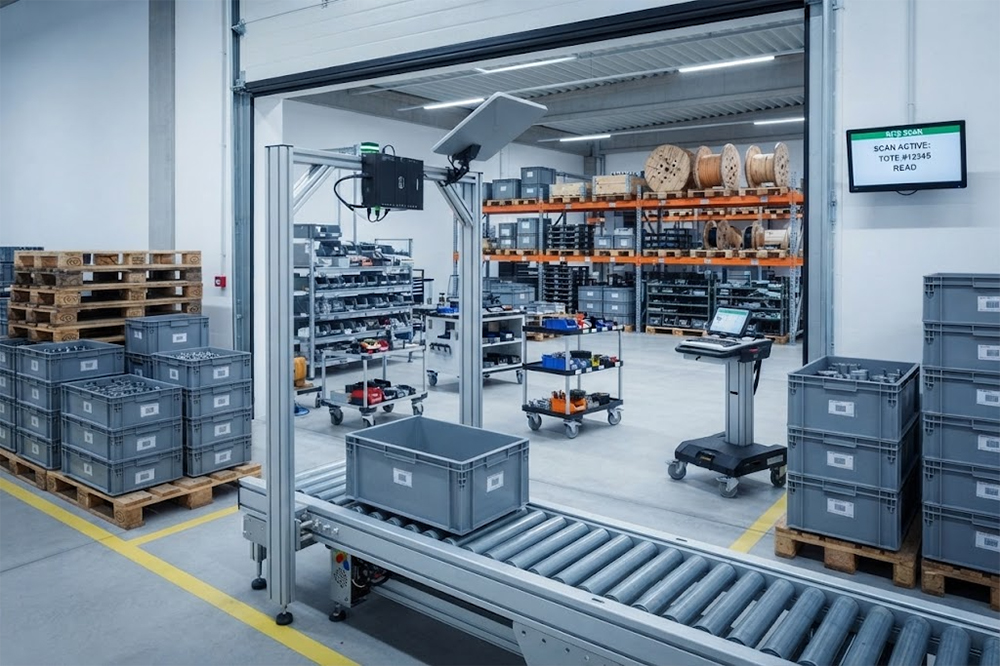
Tracking Raw Materials and Production Supplies
Factories often move raw materials between storage areas, preparation rooms, production lines, and inspection stations.Depending on the industry, RFID can be used to track:
- Raw material containers
- Component bins
- Cable reels
- Plastic crates
- Metal trays
- Pallets
- Work-in-process containers
- Packaging materials
- Spare parts
- Reusable transport boxes
This can reduce the need for workers to stop and scan each barcode manually. It can also provide better visibility into whether the correct material reached the correct production area.
However, RFID does not automatically understand the material itself. The EPC must be connected to a database record containing the part number, batch, quantity, supplier, or production order.
RFID for Work-in-Process Tracking
Work-in-process, or WIP, tracking is a common smart factory application.A product may pass through several stages:
Material preparation → assembly → testing → inspection → packaging → finished goods warehouse
An RFID tag can identify the product, tray, pallet, or reusable carrier at each stage.
The system can record:
- Which item arrived at a workstation
- When the item entered production
- Which process was completed
- Whether the item passed inspection
- Which station handled the item
- Whether the item is waiting or delayed
- When the item moved to the next stage
The correct choice depends on product size, material, production cycle, reuse frequency, and required traceability.
Long Range Does Not Mean Unlimited Reading
Smart factories contain many nearby objects, machines, shelves, and production stations. A reader that detects tags too far away may create incorrect production events.For example, a reader installed at Station A might also detect a tagged tray waiting at Station B. The software could then incorrectly record that the tray has already entered the next process.
A controlled reading zone is therefore more important than the largest possible reading distance.
Reading-zone control may involve:
- Directional antennas
- Antenna height and angle
- Reader output power
- Physical spacing
- Shielding or barriers
- Sensor triggers
- PLC signals
- Software time windows
- EPC filtering
- Direction detection
- Separate antennas for entry and exit
Antenna Position and Production Layout
Antenna installation should follow the actual movement path of the product or carrier.Common installation options include:
Side-Mounted Antenna
A side antenna may work well when products pass through a narrow conveyor or doorway. It can provide a more controlled reading area than an antenna pointed across a large room.Top-Mounted Antenna
A top-mounted antenna may suit products moving beneath a conveyor or through a defined transfer point. Tag orientation must be tested because some tags may face away from the antenna.Multiple Antennas
Multiple antennas can improve reading reliability when products have different orientations or when one antenna cannot cover the complete reading area.However, adding more antennas can also increase unwanted reads. The antenna layout should be designed around the product path and the required detection zone.
RFID Tunnel
An RFID tunnel can create a more controlled environment for cartons, trays, or containers. It may be useful when the product shape and movement direction are relatively consistent.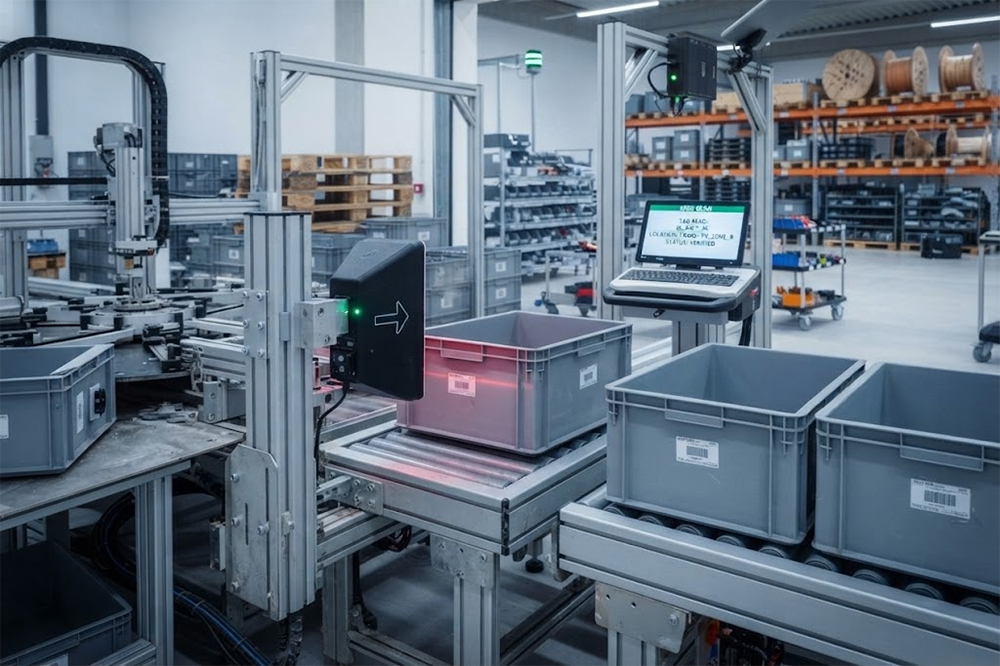
RFID and PLC Integration
Smart factories often rely on PLCs, sensors, conveyors, robots, and manufacturing execution systems.The RFID reader may communicate with the factory control system through:
- Ethernet
- TCP/IP
- Serial communication
- Digital inputs and outputs
- API
- SDK
- HTTP
- MQTT
- Industrial gateway
- Middleware platform
For example:
- A photoelectric sensor detects a container.
- The PLC triggers the RFID reading window.
- The reader identifies the EPC.
- The software checks the expected material list.
- The system confirms or rejects the material.
- The conveyor or production process continues.
Tracking Tools, Fixtures, and Production Equipment
Smart factories do not only need to track materials. They also manage tools and equipment that move between production lines, maintenance rooms, and storage areas.Possible RFID assets include:
- Assembly tools
- Inspection instruments
- Production fixtures
- Molds
- Jigs
- Dies
- Tool carts
- Maintenance cases
- Calibration equipment
- Reusable equipment containers
- Portable testing devices
For valuable tools and fixtures, RFID can also support maintenance scheduling, calibration records, and usage history.
The RFID tag provides the identity. The asset management system stores the maintenance and operational information.
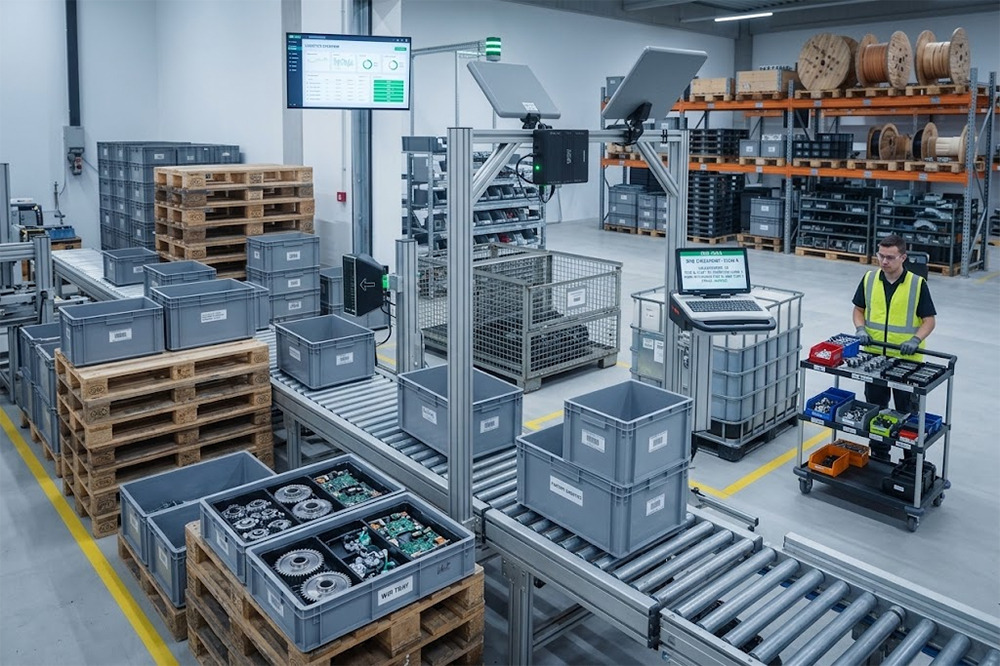
RFID for Reusable Containers and Pallets
Many factories use the same containers repeatedly between suppliers, warehouses, production lines, and finished goods areas.Without reliable tracking, reusable containers may be:
- Left at the wrong workstation
- Sent to another factory
- Held in a shipping area
- Missing from the return cycle
- Counted incorrectly
- Used for the wrong material
For example, a tagged container may be recorded when it:
- Arrives from a supplier
- Enters the raw material warehouse
- Moves to production
- Returns empty
- Enters the cleaning area
- Leaves for another facility
Can RFID Read Multiple Factory Assets?
UHF RFID readers can identify multiple tags in a reading zone. This is useful for carts, pallets, containers, and groups of work-in-process products.Actual performance depends on:
- Tag quantity
- Tag spacing
- Product material
- Metal structures
- Liquid content
- Tag orientation
- Reader output power
- Antenna configuration
- Conveyor speed
- Reading-zone size
- Software filtering
Testing should therefore include the real packaging, real carrier, actual tag placement, and normal production speed.