
To implement RFID in a warehouse, first define the inventory process, then select compatible UHF RFID tags and readers, install read points, connect RFID data to the warehouse management system, and validate read performance before expanding across the facility.
That sequence sounds simple. On an actual warehouse floor, it is not the reader that usually determines whether the project works. Tag placement, pallet composition, metal structures, liquids, antenna positioning, and the exact point where RFID data enters the WMS can change the result considerably.
From an implementation perspective, I recommend starting with one measurable warehouse process, not the entire building. Receiving is often a strong starting point because every inbound carton or pallet already has a defined transaction and a clear system event.
GS1 specifically notes that RAIN RFID can complement existing barcode processes and is particularly useful where warehouses need higher inventory productivity, larger-scale inventory counts, or visibility without line-of-sight scanning.
A fixed reader at a dock door, for example, has a very different job from a handheld rfid reader used during cycle counting. The former needs controlled portal coverage and event filtering. The latter needs mobility, comfortable ergonomics, and reliable reads around shelving.
This distinction is easy to miss during procurement.
GS1’s warehouse guidance emphasizes visibility of inbound and outbound flows and accurate inventory information rather than treating RFID as a standalone hardware installation.
The important design decision is not simply which RFID reader has the longest read range.
It is whether the system can distinguish “a pallet passed through this dock” from “a pallet happened to be within radio range.”
That is where antenna positioning, power settings, tag orientation, reader configuration, and event logic become part of the implementation rather than an afterthought.
Cardboard cartons, plastic containers, liquids, metal tools, metal racks and dense mixed pallets can behave very differently in an RFID field. GS1 notes that RAIN RFID tags can be designed for harsh warehouse conditions and can use specialized coatings or construction when exposure to moisture, dirt, impact or other conditions makes ordinary labels unsuitable.
For a pilot, I would test at least:
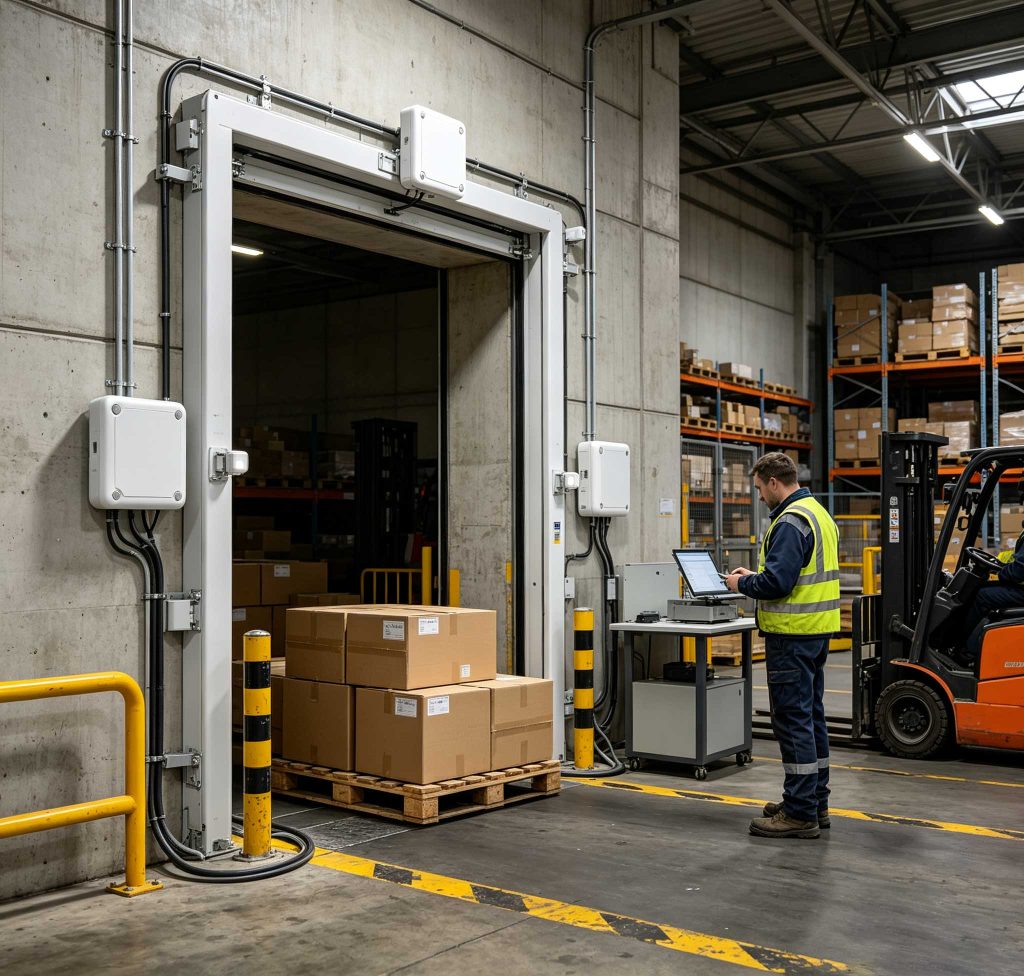 Fixed RFID readers capture tagged pallets as inventory moves through a warehouse receiving area.
For example:
Those figures should not be copied into a warehouse business case as guaranteed results. They come from a specific retail study, not every warehouse environment. The useful lesson is methodological: establish a baseline first, then measure the RFID-enabled process against it.
Another GS1 reference reports that RFID-enabled inventory counts can move from roughly 250 to 20,000 items per hour in cited applications, illustrating why RFID can change the economics of large inventory counts.
The strongest RFID implementations are rarely the ones with the most readers. They are the ones where every reader has a defined operational responsibility.
That sequence sounds simple. On an actual warehouse floor, it is not the reader that usually determines whether the project works. Tag placement, pallet composition, metal structures, liquids, antenna positioning, and the exact point where RFID data enters the WMS can change the result considerably.
From an implementation perspective, I recommend starting with one measurable warehouse process, not the entire building. Receiving is often a strong starting point because every inbound carton or pallet already has a defined transaction and a clear system event.
GS1 specifically notes that RAIN RFID can complement existing barcode processes and is particularly useful where warehouses need higher inventory productivity, larger-scale inventory counts, or visibility without line-of-sight scanning.
RFID warehouse implementation starts with the workflow
Before selecting hardware, map where inventory physically moves:- Receiving dock
- Inspection or staging area
- Put-away
- Storage locations
- Picking
- Packing
- Shipping dock
- Returns
A fixed reader at a dock door, for example, has a very different job from a handheld rfid reader used during cycle counting. The former needs controlled portal coverage and event filtering. The latter needs mobility, comfortable ergonomics, and reliable reads around shelving.
This distinction is easy to miss during procurement.
GS1’s warehouse guidance emphasizes visibility of inbound and outbound flows and accurate inventory information rather than treating RFID as a standalone hardware installation.
Choose the RFID architecture for the warehouse
A practical UHF RFID warehouse system normally combines several components:| Component | Primary role | Typical deployment |
|---|---|---|
| RFID tags | Identify cartons, pallets, products or assets | Attached to goods |
| Fixed RFID reader | Automatic tag capture | Dock doors, portals |
| RFID Antenna | Creates the RFID read zone | Portal, ceiling, workstation |
| Handheld reader | Mobile inventory operations | Aisles, cycle counting |
| RFID middleware | Filters and processes reads | Between readers and WMS |
| WMS/ERP integration | Converts reads into business events | Receiving, shipping, inventory |
It is whether the system can distinguish “a pallet passed through this dock” from “a pallet happened to be within radio range.”
That is where antenna positioning, power settings, tag orientation, reader configuration, and event logic become part of the implementation rather than an afterthought.
RFID warehouse tags need testing before mass deployment
Tag selection should happen against the actual goods.Cardboard cartons, plastic containers, liquids, metal tools, metal racks and dense mixed pallets can behave very differently in an RFID field. GS1 notes that RAIN RFID tags can be designed for harsh warehouse conditions and can use specialized coatings or construction when exposure to moisture, dirt, impact or other conditions makes ordinary labels unsuitable.
For a pilot, I would test at least:
- Empty carton
- Full carton
- Mixed-SKU pallet
- Liquid-containing product
- Metal-containing product
- Tag placed in its final production position
Build the pilot before expanding the RFID system
A warehouse RFID pilot should answer measurable questions.For example:
- Can the system identify the intended tagged goods?
- Are neighboring tags being captured accidentally?
- Does pallet composition affect readability?
- Can the reader distinguish inbound from outbound movement?
- How quickly does the WMS receive the event?
- What happens when a tag cannot be read?
- Can operators continue using barcode processes as a fallback?
Those figures should not be copied into a warehouse business case as guaranteed results. They come from a specific retail study, not every warehouse environment. The useful lesson is methodological: establish a baseline first, then measure the RFID-enabled process against it.
Another GS1 reference reports that RFID-enabled inventory counts can move from roughly 250 to 20,000 items per hour in cited applications, illustrating why RFID can change the economics of large inventory counts.
What should be measured during the pilot?
At minimum, record:- Read rate by SKU or product type
- Reads per transaction
- Missed reads
- False reads
- Inventory count time
- Receiving transaction time
- Picking or shipping errors
- Manual interventions
- WMS event latency
The strongest RFID implementations are rarely the ones with the most readers. They are the ones where every reader has a defined operational responsibility.