
How RFID Is Used in Inventory Management
How rfid is used in inventory management is through automatic product identification, real-time tracking, and digital inventory updates. RFID tags and readers help businesses monitor stock movement, reduce manual errors, and maintain accurate inventory information across warehouses, stores, and supply chains.How RFID Is Used in Inventory Management Today
Inventory management has changed from simple counting into a continuous data process.Modern warehouses, retailers, hospitals, and manufacturers need to know more than how many products they own.
They need to know:
- Where each item is located
- When it moved
- Who handled it
- Whether the inventory record matches reality
A warehouse management system showed 200 units available, but workers could only locate 186 units on the shelves.
The missing 14 items were not necessarily lost.
They were often somewhere between receiving, storage, transfer, or shipment.
This is where RFID creates a different approach.
Instead of relying on periodic manual checks, RFID continuously connects physical products with digital inventory systems.
The basic process is:
- RFID tags are attached to products.
- RFID readers capture product information wirelessly.
- Software updates inventory records automatically.
- Managers receive real-time visibility.
According to GS1, RFID enables automatic identification and data capture by using radio communication between RFID tags and readers, supporting supply chain visibility and operational efficiency.
RFID Inventory Management Working Process
A complete RFID inventory system contains several connected components.| Component | Function |
|---|---|
| RFID Tags | Store unique product identity information |
| RFID Readers | Capture product data wirelessly |
| RFID Antennas | Extend and control reading coverage |
| Software Platform | Processes inventory information |
| Enterprise System | Uses data for business decisions |
How RFID Tags Support Inventory Management
1. Assigning Digital Identity to Products
Every RFID-tagged product receives a unique electronic identity.Unlike traditional labels, RFID tags allow individual item recognition.
For example:
A warehouse may contain thousands of identical products.
Barcode:
- Same product code
- Manual scanning required
- Individual identification
- Automatic recognition
- Movement history available
2. Capturing Product Movement Automatically
Inventory accuracy depends on knowing when products move.RFID readers can collect information when products:
- Enter warehouses
- Leave storage areas
- Move between departments
- Pass checkout stations
3. Updating Inventory Data in Real Time
Traditional inventory systems often depend on scheduled counting.RFID provides continuous information flow.
Examples:
A retailer receives new products.
RFID automatically records incoming inventory.
A customer purchases an item.
The system updates stock availability.
A warehouse ships products.
Inventory records change immediately.
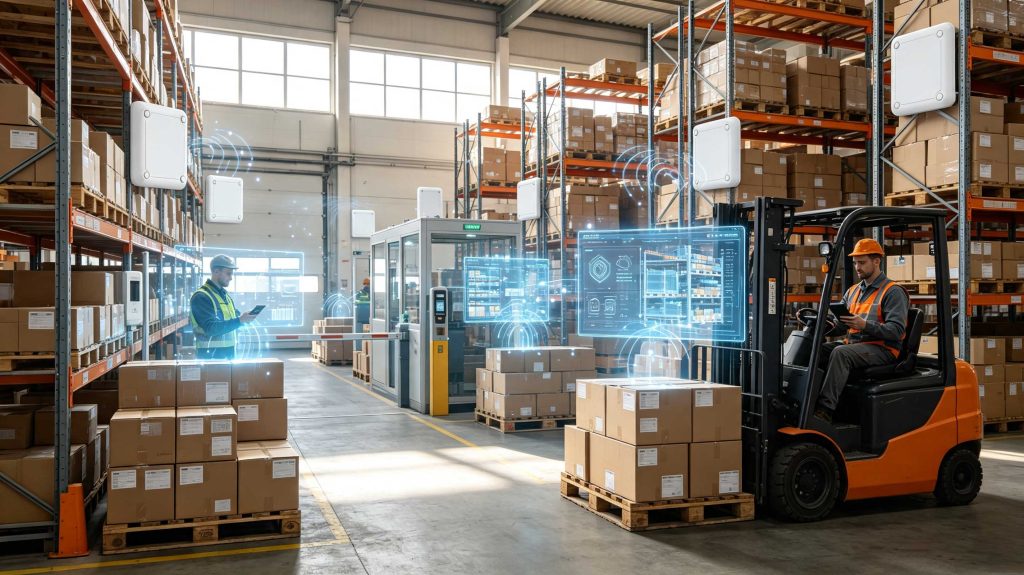
Why Companies Use RFID for Inventory Management
Improved Inventory Accuracy
Manual inventory counting creates unavoidable risks.Common problems include:
- Incorrect counting
- Missed product movement
- Delayed updates
- Human recording errors
Research from Auburn University RFID Lab has shown that RFID-based retail implementations can significantly improve inventory accuracy, with many deployments achieving accuracy levels above 95%.
Faster Inventory Counting
One of the strongest RFID advantages is speed.Traditional counting:
- Product by product scanning
- Manual recording
- Longer operation time
- Multiple item identification
- Faster inventory checks
- Reduced labor requirements
- Distribution centers
- Retail chains
- Manufacturing facilities
Better Warehouse Visibility
Warehouses are dynamic environments.Products constantly move.
RFID helps companies understand:
- Current inventory levels
- Product location
- Movement history
- Storage efficiency
RFID Inventory Management Applications
Retail Inventory Management
Retail companies use RFID for:- Shelf monitoring
- Stock replenishment
- Online order accuracy
- Store inventory counting
Warehouse and Distribution Centers
RFID supports:- Receiving automation
- Picking verification
- Shipment confirmation
- Inventory auditing
Healthcare Inventory Management
Hospitals use RFID to manage:- Medical supplies
- Equipment tracking
- Consumable inventory
Manufacturing Inventory Control
Manufacturers use RFID for:- Raw materials
- Components
- Tools
- Production tracking
RFID vs Barcode in Inventory Management
| Feature | RFID | Barcode |
|---|---|---|
| Reading Method | Wireless communication | Optical scanning |
| Multiple Items | Yes | Limited |
| Direct Visibility | Not required | Required |
| Automation Level | High | Medium |
| Real-Time Tracking | Strong | Limited |
| Manual Labor | Lower | Higher |
Many companies use both.
However, when inventory volume increases, RFID provides stronger automation capability.
Factors Affecting RFID Inventory Performance
Tag Selection
Different products require different RFID tags.Consider:
- Product material
- Storage environment
- Reading distance
- Durability requirements
Reader Deployment
Correct reader placement improves system reliability.Common locations:
- Warehouse gates
- Inventory stations
- Retail checkout areas
- Production lines
Software Integration
RFID data becomes valuable when connected with:- ERP systems
- WMS systems
- Retail platforms
- Database systems