
How does a RFID tag work?
A RFID tag works by storing identification data in a microchip and communicating with an RFID reader through radio frequency signals. When activated, the tag sends stored information back to the reader, enabling automatic identification, tracking, and digital management of physical objects.Real Experience: Understanding RFID Tags From Industrial Deployment
When customers ask how does a rfid tag work, they often expect a simple answer: “the tag sends information to a reader.”Technically, that is true.
But during real RFID deployments, the process is much more detailed.
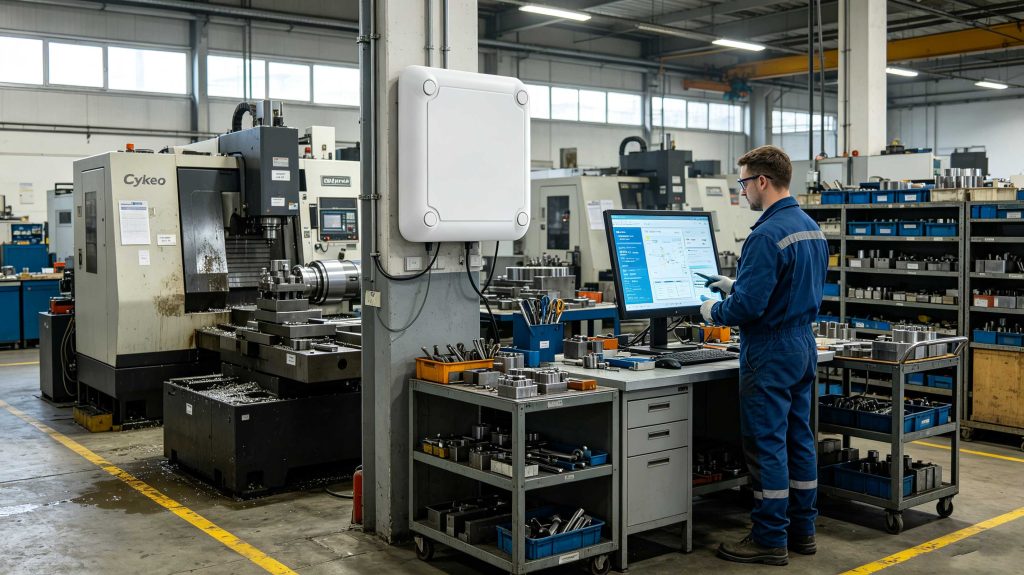
I have worked with Cykeo RFID systems in industrial environments where RFID tags were attached to tools, warehouse materials, production components, and managed assets. The biggest lesson from field testing is that an RFID tag is not an independent tracking device.
It does not continuously broadcast its location.
It waits.
When an RFID reader enters its communication range, the tag responds.
This small difference changes how companies design tracking systems.
During one industrial equipment management project, RFID tags were installed on frequently moved tools. Initial testing showed inconsistent reads because some tags were mounted close to metal surfaces.
The issue was not the RFID chip itself.
The problem was the interaction between:
- Tag antenna design
- Material environment
- Reader position
- Signal conditions
This is why professional RFID engineering focuses on the entire system rather than only choosing a tag with a longer reading distance.
According to GS1, RFID enables automatic identification by using electronic tags and readers to exchange information through radio frequency communication.
How RFID Tags Communicate With Readers
The basic RFID tag working principle
An RFID tag contains several important components:| Component | Function |
|---|---|
| RFID Chip | Stores identification information |
| RFID Antenna | Receives and sends radio signals |
| Substrate | Supports the electronic structure |
| Protective Material | Provides environmental protection |
The RFID chip then processes the signal and sends stored information back to the reader.
The complete process happens in milliseconds.
RFID communication process:
- RFID reader emits radio frequency energy
- Tag antenna receives the signal
- RFID chip processes stored data
- Tag sends response information
- Reader transfers data to software systems
Different Types of RFID Tags and How They Work
Passive RFID tags
Passive RFID tags are the most widely used RFID type.They do not contain internal batteries.
Instead, they receive energy from the RFID reader signal.
Advantages include:
- Smaller size
- Lower maintenance requirements
- Longer service life
- Lower deployment cost
- Warehouse inventory
- Retail products
- Logistics tracking
- Asset identification
Active RFID tags
Active RFID tags include internal batteries.They can actively transmit signals and usually provide longer communication distances.
Common applications include:
- Large equipment tracking
- Real-time location systems
- Vehicle monitoring
What Information Does an RFID Tag Store?
Understanding RFID tag data
A common misunderstanding is that RFID tags store large amounts of product information.In most professional applications, RFID tags mainly store identification data.
Examples include:
- Unique electronic product code
- Asset identification number
- Serial number
- Product reference information
For example:
A warehouse pallet RFID tag may contain only an identification number.
The enterprise system connects that number with:
- Product details
- Inventory quantity
- Storage location
- Shipping records
Why RFID Tag Design Matters in Real Applications
RFID tags are not one-size-fits-all devices
Choosing an RFID tag requires understanding the working environment.During actual deployment, engineers consider:
| Factor | Influence |
|---|---|
| Material surface | Metal and liquid may affect signals |
| Temperature | Impacts tag durability |
| Reading distance | Determines tag and reader matching |
| Application frequency | Affects technology selection |
| Installation method | Influences communication stability |
A paper label RFID tag may work well on cardboard packaging.
The same tag may perform poorly when attached directly to metal equipment.
In industrial environments, specialized on-metal RFID tags are often required.
RFID Tag Applications in Modern Industries
Where RFID tags create practical value
RFID tags are used wherever companies need automatic identification.| Industry | RFID Tag Application |
|---|---|
| Logistics | Shipment tracking |
| Manufacturing | Production component management |
| Retail | Inventory visibility |
| Healthcare | Medical equipment tracking |
| Aviation | Tool management |
| Energy | Inspection asset monitoring |

How RFID Tags Improve Automated Tracking
Moving from manual records to digital identification
Traditional tracking methods depend heavily on human input.Employees scan products.
Operators record movements.
Managers update systems.
RFID changes this workflow.
When tagged items pass through RFID readers, information can be collected automatically.
Benefits include:
- Faster inventory counting
- Reduced manual errors
- Better asset visibility
- Improved process control
Cykeo RFID Tags: Designed for Practical Applications
From RFID tag communication to business intelligence
Understanding how does a rfid tag work requires more than knowing how radio signals move.The real value appears when RFID tags become part of a complete identification system.
Cykeo RFID solutions are designed for:
- Industrial asset tracking
- Warehouse inventory management
- Manufacturing automation
- Logistics identification
- Smart equipment management
It creates a reliable connection between physical assets and digital systems.