
Yes, many RFID tags can be reused, provided their memory is writable and the tag remains physically functional. Reusable UHF RFID tags can be read, rewritten, reassigned, and returned to service. However, permanent memory locks, tag-kill commands, damaged antennas, adhesive failure, or application-specific security policies can make a tag unsuitable for another cycle.
In practical RFID projects, I do not treat “reusable” as a simple yes-or-no specification. During tag deployment and recovery work, the more important questions are whether the EPC can be rewritten, whether the previous data can be cleared or replaced, and whether the tag still performs reliably after repeated handling.
GS1’s current EPC Tag Data Standard defines the memory structure used by Gen 2 RFID tags, while the Gen2 standard provides commands for writing and controlling tag memory.
A hard plastic RFID tag attached to a reusable tool can circulate for years. A low-cost paper RFID label attached to disposable retail packaging may technically support rewriting, but removing and reapplying it is rarely economical.
GS1 notes that RAIN RFID tags commonly carry no more than 8 KB of data, while simple license-plate-style tags may use only 96-bit or 128-bit identifiers. That makes many RFID applications naturally suited to storing an identifier and updating the associated record in software rather than repeatedly writing large amounts of information to the tag.
A Gen2/RAIN RFID tag contains several logical memory areas. GS1 identifies Reserved, EPC, TID, and optional User Memory areas. The EPC memory normally carries the electronic product identifier, while User Memory can hold additional application information when supported.
For reusable tags, this means an operator can potentially:
GS1’s RAIN RFID guidance explains that memory can be protected with password-based lock mechanisms, and permalock can make a lock status permanent. Once the relevant memory has been permanently locked, ordinary rewriting is no longer available.
That is why “rewritable RFID tag” should be treated as a system requirement, not simply a product label.
This is where RFID engineering becomes less about the chip and more about the physical lifecycle.
A reusable plastic tag mounted to a metal tool needs a different construction from a paper label attached to a carton. If the adhesive fails after cleaning, the chip may still be perfectly healthy—but the deployment has failed.
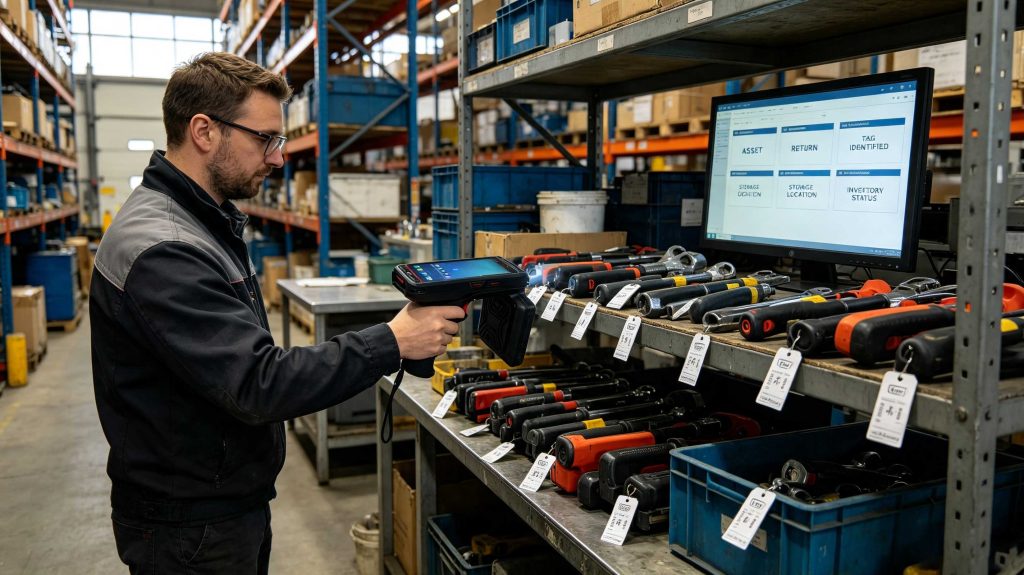 Durable RFID tags can circulate with reusable tools and assets through repeated issue, return, and inventory cycles.
A reusable tag is only useful if the system can reliably identify it before and after rewriting. Cykeo RFID solutions can be configured around workflows such as tag registration, data writing, filtering, verification, inventory, and item reassignment.
For desktop tag-management work, a controlled near-field reading zone is particularly useful. It reduces the chance of accidentally writing the wrong tag when several tagged objects are sitting nearby.
A good reuse workflow therefore separates:
Identify → Verify → Rewrite → Confirm → Reassign
That sequence sounds simple. On a busy registration desk, it prevents a surprisingly expensive mistake: changing the identifier on the wrong physical asset.
GS1 describes the RFID infrastructure itself as a combination of readers and tags, with readers sending standardized commands to read and write tag data. Passive UHF tags receive operating energy from the reader’s radio signal and respond through backscatter.
Actual service life depends on:
A tag that works perfectly on a test bench may behave differently after hundreds of cleaning cycles, repeated attachment and removal, or installation on a metal tool.
A tag may be technically rewritable but commercially unsuitable for reuse. Conversely, a durable RFID tag with controlled writing, verification, and asset reassignment can become a long-term identification component.
That difference is usually visible only after the system has been operating for months.
Cykeo RFID solutions are particularly suited to workflows where tags need to be registered, written, verified, filtered and reassigned rather than simply read once.
A typical reusable-tag workflow looks like this:
Tag → RFID Reader → Data Processing → Database → Verification → Reassignment
This architecture matters in tool rooms, hospital equipment management, reusable containers, libraries and internal asset circulation. GS1 confirms that RAIN RFID tags can store and update additional information in User Memory, while the EPC can act as a pointer to information held in an external database.
In practical RFID projects, I do not treat “reusable” as a simple yes-or-no specification. During tag deployment and recovery work, the more important questions are whether the EPC can be rewritten, whether the previous data can be cleared or replaced, and whether the tag still performs reliably after repeated handling.
GS1’s current EPC Tag Data Standard defines the memory structure used by Gen 2 RFID tags, while the Gen2 standard provides commands for writing and controlling tag memory.
What makes an RFID tag reusable?
A reusable RFID tag normally has three characteristics:- Writable memory — the EPC or User Memory must not be permanently locked.
- Functional RF structure — the chip and antenna must still communicate reliably.
- A suitable application lifecycle — the tag must be designed for repeated identification rather than one-way disposal.
A hard plastic RFID tag attached to a reusable tool can circulate for years. A low-cost paper RFID label attached to disposable retail packaging may technically support rewriting, but removing and reapplying it is rarely economical.
GS1 notes that RAIN RFID tags commonly carry no more than 8 KB of data, while simple license-plate-style tags may use only 96-bit or 128-bit identifiers. That makes many RFID applications naturally suited to storing an identifier and updating the associated record in software rather than repeatedly writing large amounts of information to the tag.
Rewritable RFID tags and memory locking
The part that often gets missed is memory control.A Gen2/RAIN RFID tag contains several logical memory areas. GS1 identifies Reserved, EPC, TID, and optional User Memory areas. The EPC memory normally carries the electronic product identifier, while User Memory can hold additional application information when supported.
For reusable tags, this means an operator can potentially:
- Read the existing EPC.
- Verify the tag identity.
- Rewrite the EPC or permitted User Memory.
- Associate the tag with a new item.
- Test the rewritten data.
- Return the tag to service.
GS1’s RAIN RFID guidance explains that memory can be protected with password-based lock mechanisms, and permalock can make a lock status permanent. Once the relevant memory has been permanently locked, ordinary rewriting is no longer available.
That is why “rewritable RFID tag” should be treated as a system requirement, not simply a product label.
Where reusable RFID tags make practical sense
The strongest reuse cases are environments where the tagged object itself returns to the organization.| Application | RFID reuse potential | Typical reason |
|---|---|---|
| Tool management | High | Tools circulate repeatedly |
| Reusable transport containers | High | Containers return to warehouses |
| Library assets | High | Books and equipment remain in circulation |
| Hospital equipment | High | Equipment is repeatedly issued and returned |
| Garment samples | High | Items move between stores and facilities |
| Returnable packaging | High | Containers complete multiple logistics cycles |
| Disposable retail packaging | Low | Tag often leaves with the product |
| Single-use labels | Low | Removal and reapplication are inefficient |
A reusable plastic tag mounted to a metal tool needs a different construction from a paper label attached to a carton. If the adhesive fails after cleaning, the chip may still be perfectly healthy—but the deployment has failed.
How Cykeo approaches RFID tag reuse
For practical RFID deployments, tag management and reader performance have to be considered together.A reusable tag is only useful if the system can reliably identify it before and after rewriting. Cykeo RFID solutions can be configured around workflows such as tag registration, data writing, filtering, verification, inventory, and item reassignment.
For desktop tag-management work, a controlled near-field reading zone is particularly useful. It reduces the chance of accidentally writing the wrong tag when several tagged objects are sitting nearby.
A good reuse workflow therefore separates:
Identify → Verify → Rewrite → Confirm → Reassign
That sequence sounds simple. On a busy registration desk, it prevents a surprisingly expensive mistake: changing the identifier on the wrong physical asset.
GS1 describes the RFID infrastructure itself as a combination of readers and tags, with readers sending standardized commands to read and write tag data. Passive UHF tags receive operating energy from the reader’s radio signal and respond through backscatter.
Reuse does not mean unlimited reuse
An RFID tag has no universal “reuse count” that applies to every tag model.Actual service life depends on:
- Chip and memory technology
- Number and type of write operations
- Antenna construction
- Tag substrate
- Adhesive
- Temperature exposure
- Water, chemicals, and abrasion
- Mounting surface
- Reader power and operating conditions
- Whether memory has been locked or permanently locked
A tag that works perfectly on a test bench may behave differently after hundreds of cleaning cycles, repeated attachment and removal, or installation on a metal tool.
A practical RFID tag reuse checklist
Before selecting a reusable RFID tag, confirm:- Memory: Is EPC memory rewritable?
- Security: Is permanent locking required?
- Physical design: Can the tag survive the asset’s environment?
- Mounting: Will adhesive, screws, rivets, or a housing be used?
- Reading: Can the installed tag be reliably identified?
- Writing: Can the required reader rewrite it consistently?
- Software: Can the old asset association be removed from the database?
- Verification: Is there a read-after-write validation step?
The key engineering point
Reuse is a lifecycle decision, not merely a memory feature.A tag may be technically rewritable but commercially unsuitable for reuse. Conversely, a durable RFID tag with controlled writing, verification, and asset reassignment can become a long-term identification component.
That difference is usually visible only after the system has been operating for months.
Cykeo RFID Tag Technical Advantages for Reusable Applications
For reusable RFID projects, the tag itself is only one component. The reader, writing software, antenna, database and physical mounting method determine whether reuse is actually practical.Cykeo RFID solutions are particularly suited to workflows where tags need to be registered, written, verified, filtered and reassigned rather than simply read once.
A typical reusable-tag workflow looks like this:
Tag → RFID Reader → Data Processing → Database → Verification → Reassignment
This architecture matters in tool rooms, hospital equipment management, reusable containers, libraries and internal asset circulation. GS1 confirms that RAIN RFID tags can store and update additional information in User Memory, while the EPC can act as a pointer to information held in an external database.
Why Cykeo RFID equipment fits tag-reuse workflows
- Controlled writing: Suitable for registration and reassignment processes.
- Tag filtering: Helps operators isolate the intended tag before writing.
- Read-after-write verification: Allows the newly written EPC or data to be checked immediately.
- Near-field desktop operation: Useful where accidental reads or writes to nearby tags must be minimized.
- Developer support: C# and Java development resources can simplify integration with existing management software.
- USB/Type-C desktop connectivity: Practical for tag registration stations and administrative workstations.