
Can RFID be used to track people, products, equipment, and inventory? Yes, RFID can track tagged items by identifying them as they pass readers or enter defined detection zones. When connected to tracking software, multiple readers can record movement between locations and update inventory records. However, ordinary RFID does not automatically provide GPS-style coordinates or continuous location updates everywhere.
That distinction matters in a warehouse. A reader installed at a loading-bay entrance may register a tagged container as it passes through, while a reader at a storage area can record its subsequent arrival. The software connects these events to build a movement history. If neither reader detects the container, the system cannot simply assume where it is.
RFID tracking is therefore best understood as a combination of radio-frequency identification, reader placement, tagged assets, and software that interprets detection events.
For businesses considering industrial RFID, the practical question is not only whether a tag can be read. It is whether the system can reliably capture the movements that matter to the operation.
A typical passive UHF RFID tracking system contains four main elements:
Passive UHF tags do not require an onboard battery to communicate with a reader. The reader supplies energy through its radio signal, and the tag responds by backscattering information. This makes passive RFID suitable for many applications involving large numbers of relatively inexpensive tagged items.
The pallet or individual products carry RFID tags. As the shipment passes an RFID reading point, the reader detects the tags and sends their identifiers to the host application. The software checks the expected shipment information and records the receiving event.
Later, another reader may record the pallet leaving a storage zone or passing through a dispatch portal.
The application can then show:
At receiving, a reader can detect multiple compatible tags within its reading zone. At dispatch, the system can compare detected items with shipment records. During cycle counting, RFID can help reconcile physical stock with the inventory database.
The main operational advantage is reduced dependence on manually scanning every item one at a time. However, the actual result depends on tag placement, packaging materials, reader configuration, and the inventory process.
A useful real-world example comes from research by Auburn University’s RFID Lab. A 2013 field study examined RFID-enabled inventory visibility across 13 stores over 23 weeks. The researchers reported an approximately 26% reduction in inventory record inaccuracy in the first study. A second study involving 62 stores found that the effect varied by product category, ranging from no statistically significant improvement to 81%.
These results are evidence that RFID can improve inventory visibility under suitable conditions, not a guarantee that every implementation will deliver the same improvement.
Readers installed at entrances, issue counters, or designated storage locations can record when tagged items are detected. The software can associate those events with an asset register and help staff investigate missing equipment or overdue returns.
For example, if a tagged tool leaves a controlled tool room, a reader can record its detection at the exit. A corresponding return event can be recorded when it re-enters the reading zone.
The system’s value depends on the workflow. If the tool can leave through an unmonitored doorway, the software may not capture the departure. RFID improves the visibility of observed events; it does not eliminate every possible blind spot.
A reader at a workstation may confirm that a tagged component has arrived. Another reading point farther down the line may record its movement to the next process. When the identifiers are linked to production orders, the software can build a record of where and when items were detected.
This approach is especially useful when the physical workflow is repetitive and reading points can be installed at predictable locations.
Metal machinery, liquid-filled containers, densely packed products, and closely spaced tags can affect read performance. Tag selection and antenna positioning should therefore be tested with the actual products rather than decided from a reader’s maximum advertised range alone.
If each asset has an identifier linked to a shared or synchronized database, a company can review its latest recorded detection and movement history. This can make it easier to investigate unreturned containers, reconcile transfers, and understand how reusable assets circulate.
There is an important limitation: RFID tracking is only as complete as the reading infrastructure and data-sharing process. A container passing through a location without a compatible reader may not generate an event.
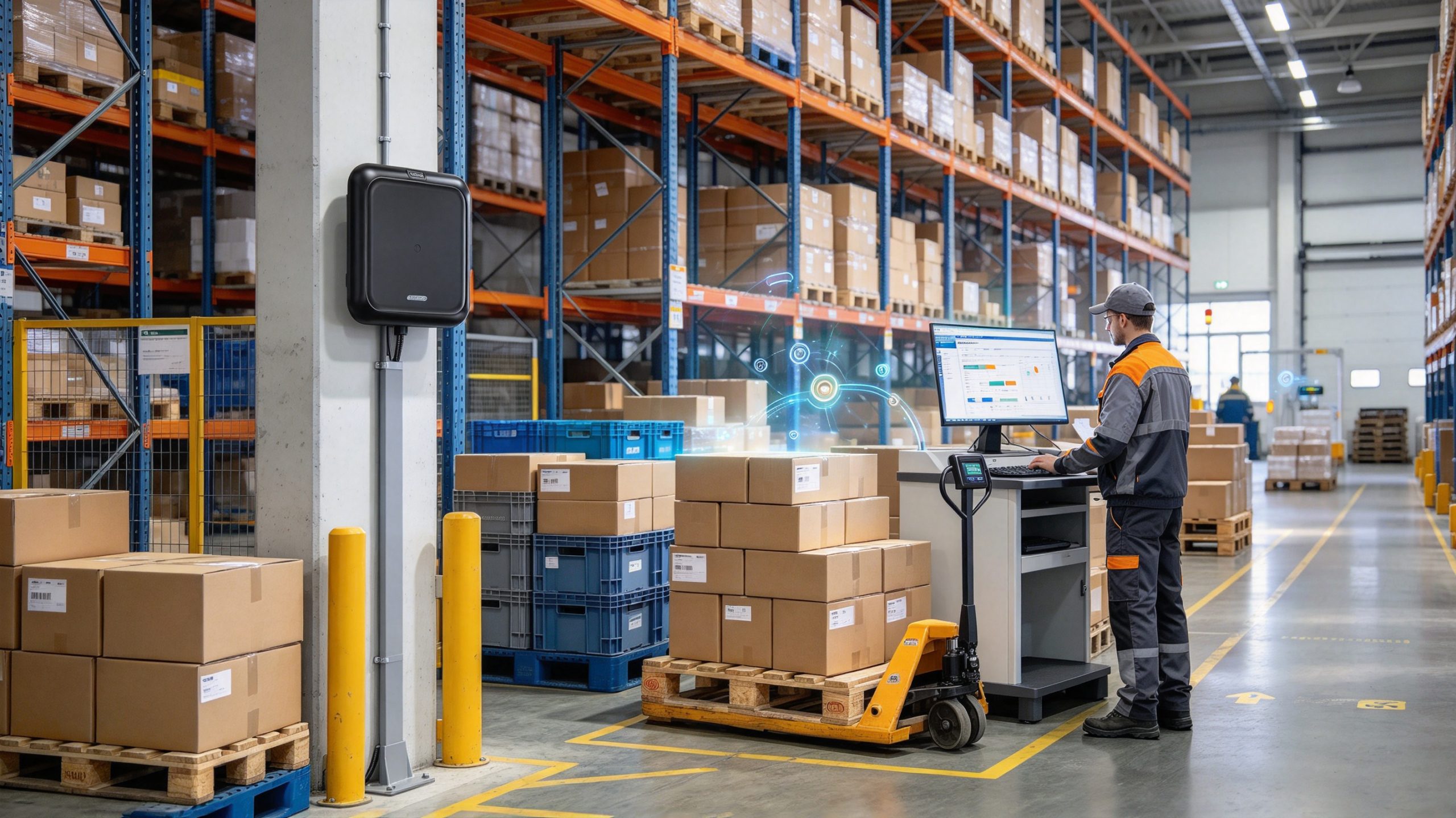 Fixed RFID reading points record tagged inventory movements and help warehouse software maintain more accurate stock records.
For most warehouse applications, it is important to distinguish three levels of tracking.
A fixed RFID reader does not automatically calculate the exact coordinates of every tag it detects. The reader’s antenna pattern, mounting position, radio environment, and tag response determine which tags can be observed. Software may associate a detection with a predefined zone, but that zone is not necessarily the object’s precise position.
That distinction matters in a warehouse. A reader installed at a loading-bay entrance may register a tagged container as it passes through, while a reader at a storage area can record its subsequent arrival. The software connects these events to build a movement history. If neither reader detects the container, the system cannot simply assume where it is.
RFID tracking is therefore best understood as a combination of radio-frequency identification, reader placement, tagged assets, and software that interprets detection events.
For businesses considering industrial RFID, the practical question is not only whether a tag can be read. It is whether the system can reliably capture the movements that matter to the operation.
How Does RFID Tracking Work?
RFID stands for Radio Frequency Identification. An RFID system uses radio signals to communicate between a reader and an electronic tag attached to an object, product, container, or other item.A typical passive UHF RFID tracking system contains four main elements:
- RFID tags: Store identification data associated with individual items or assets.
- RFID readers: Detect tags within their effective interrogation zones.
- Antennas: Transmit and receive radio-frequency signals, either as separate components or integrated into the reader.
- Tracking software: Associates tag identifiers with asset records and processes detection events into useful information.
Passive UHF tags do not require an onboard battery to communicate with a reader. The reader supplies energy through its radio signal, and the tag responds by backscattering information. This makes passive RFID suitable for many applications involving large numbers of relatively inexpensive tagged items.
What happens when an item moves?
Imagine a distribution center receiving a pallet of packaged products.The pallet or individual products carry RFID tags. As the shipment passes an RFID reading point, the reader detects the tags and sends their identifiers to the host application. The software checks the expected shipment information and records the receiving event.
Later, another reader may record the pallet leaving a storage zone or passing through a dispatch portal.
The application can then show:
- Which tagged items were detected.
- When a recorded movement occurred.
- Which reader or designated zone detected the item.
- Whether the observed movement matches the expected workflow.
- Whether an item appears to be missing from a scheduled inventory or shipment.
What Can RFID Be Used to Track?
RFID tracking can support several different business processes. The most suitable setup depends on whether a company needs item identification, movement history, location-zone awareness, or more detailed localization.1. Inventory and warehouse stock
RFID can help warehouses identify tagged cartons, pallets, bins, and individual products without requiring staff to scan each barcode separately.At receiving, a reader can detect multiple compatible tags within its reading zone. At dispatch, the system can compare detected items with shipment records. During cycle counting, RFID can help reconcile physical stock with the inventory database.
The main operational advantage is reduced dependence on manually scanning every item one at a time. However, the actual result depends on tag placement, packaging materials, reader configuration, and the inventory process.
A useful real-world example comes from research by Auburn University’s RFID Lab. A 2013 field study examined RFID-enabled inventory visibility across 13 stores over 23 weeks. The researchers reported an approximately 26% reduction in inventory record inaccuracy in the first study. A second study involving 62 stores found that the effect varied by product category, ranging from no statistically significant improvement to 81%.
These results are evidence that RFID can improve inventory visibility under suitable conditions, not a guarantee that every implementation will deliver the same improvement.
2. Tools, equipment, and fixed assets
Businesses can attach RFID tags to tools, reusable containers, maintenance equipment, and other assets that frequently move between departments or work areas.Readers installed at entrances, issue counters, or designated storage locations can record when tagged items are detected. The software can associate those events with an asset register and help staff investigate missing equipment or overdue returns.
For example, if a tagged tool leaves a controlled tool room, a reader can record its detection at the exit. A corresponding return event can be recorded when it re-enters the reading zone.
The system’s value depends on the workflow. If the tool can leave through an unmonitored doorway, the software may not capture the departure. RFID improves the visibility of observed events; it does not eliminate every possible blind spot.
3. Products moving through production
In manufacturing, RFID can help associate materials, work-in-progress containers, and finished goods with production stages.A reader at a workstation may confirm that a tagged component has arrived. Another reading point farther down the line may record its movement to the next process. When the identifiers are linked to production orders, the software can build a record of where and when items were detected.
This approach is especially useful when the physical workflow is repetitive and reading points can be installed at predictable locations.
Metal machinery, liquid-filled containers, densely packed products, and closely spaced tags can affect read performance. Tag selection and antenna positioning should therefore be tested with the actual products rather than decided from a reader’s maximum advertised range alone.
4. Returnable transport items and logistics assets
Reusable pallets, totes, bins, and containers can circulate between factories, distribution centers, transport providers, and customers. RFID can help record their movement at participating facilities.If each asset has an identifier linked to a shared or synchronized database, a company can review its latest recorded detection and movement history. This can make it easier to investigate unreturned containers, reconcile transfers, and understand how reusable assets circulate.
There is an important limitation: RFID tracking is only as complete as the reading infrastructure and data-sharing process. A container passing through a location without a compatible reader may not generate an event.
Can RFID Track an Item’s Exact Location?
RFID can help determine where an item was detected, but the level of location detail depends on the system design. A fixed reader usually identifies tags within its effective reading zone. A network of readers can provide more detailed movement records, while specialized RFID localization systems may estimate position using additional measurements.For most warehouse applications, it is important to distinguish three levels of tracking.
| Tracking method | What the system can tell you | Typical application |
|---|---|---|
| Single fixed RFID reader | A tag was detected within the reader’s effective zone | Inventory stations and tool rooms |
| Multiple fixed readers | A tag was detected at different monitored points | Warehouse movement and shipping verification |
| Specialized RFID localization | An estimated position based on the system’s measurement method | Selected indoor tracking applications |
| GPS-based tracking | Geographic position calculated using satellite positioning | Vehicles and outdoor logistics |