
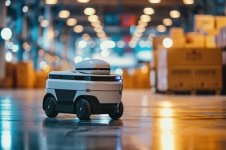
Autonomous mobile robots are changing how materials, components, and finished goods moving through warehouses, factors, hospitals, retail facilities, and logistics centers. Unlike traditional automated guided vehicles that usually follow fixed routes, AMRs use sensors, cameras, mapping software, and onboard intelligence to navigate changing environments. They can avoid obstacles, select alternative routes, and work alongside people without requiring extensive permanent infrastructure.
A recent study by MarkNtel Advisors Highlights that the autonomous mobile robots industry was valued at USD 2.79 billion in 2025. It is projected to grow from USD 2.94 billion in 2026 to USD 8.15 billion by 2032, registering a CAGR of 18.52% during 2026–2032. Growth reflects warehouse automation, e-commerce fulfillment, manufacturing modernization, labor availability challenges, and advances in navigation technology.
Warehouses Need More Adaptable Automation
Warehouses manage frequent movements between receiving zones, storage racks, picking stations, packing areas, and shipping racks. Repetitive transportation can consume employee time while exposing workers to lifting, pushing, pulling, and awkward postures. AMRs can move shelves, pallets, containers, and individual orders between these locations, allowing employees to concentrate on inspection, picking, packing, and exception handling.The International Federation of Robotics Explains that AMRs are commonly used to transport goods within warehouses, reducing the time employees spend fetching and carrying materials. Their flexible navigation also allows facilities to alter routes and workflows without installing fixed tracks or conveyor systems.
E-Commerce Fulfilment Encourages Faster Movement
Online retailers handle broad product ranges, flowing order volumes, seasonal peaks, and expectations for shorter delivery times. Traditional warehouse layouts may struggle to respond when order patterns change rapidly. AMRs can be added to selected workflows and redirected through software as fulfillment priorities shift.Goods-to-person systems use mobile robots to bring products or storage units directly to employees. This can reduce walking distances and improve the flow of orders through picking stations. Some advanced systems also combine AMRs with robotic arms, machine vision, and warehouse-management software to support automated picking and consolidation.
Manufacturing Gains Flexible Internal Logistics
Factories require continuous movement of raw materials, tools, components, work-in-progress items, and completed products. AMRs can connect storage areas with assembly lines and production cells without relying entirely on forklifts or manually operated carts.Their routes can be updated when machinery is related or production schedules change. This flexibility is valid in facilities producing several product variations. Mobile robots equipped with lifting systems, conveyors, or robotic arms can also perform loading, unloading, inspection, and material-handling tasks across multiple workstations.
Navigation Technology Improves Independence
AMRs commonly use simultaneous localization and mapping, known as SLAM, to understand their location and build a representation of the surrounding environment. LiDAR, cameras, ultrasonic sensors, wheel encoders, and artificial intelligence help robots identify obstacles and calculate suitable routes.Fleet management software coordinates multiple robots, assigns tasks, manages charging, and prevents congestion. Communication standards are also becoming important as facilities deploy equipment from different suppliers. An emerging ISO interoperability standard addresses communication protocols intended to help industrial AMR systems from multiple vendors work together.
Workplace Safety Requires Careful Integration
AMRs can reduce exposure to reactive material movement, but introducing mobile equipment creates new safety responsibilities. Facilities must evaluate pedestrian routes, intersections, loading areas, emergency stops, speed limits, sensor performance, maintenance procedures, and communication between robots and workers.The Occupational Safety and Health Administration's warehouse guidance identities material handling, ergonomic risks, powered vehicles, and robotics among workplace concerns. Effective deployment therefore requires risk assessments, employee training, clear operating zones, and procedures for responding to faults or unexpected robot behavior.
Software Integration Determines Operational Value
A mobile robot provides greater value when it exchanges information with warehouse-management, enterprise-resource-planning, manufacturing-execution, and inventory systems. Integration allows the robot fleet to receive tasks automatically and report completion, delays, battery status, or operational errors.The growing role of autonomous mobile robots reflects a wider transition toward flexible, data-led operations. Continued development will depend on reliable navigation, workplace safety, software interoperability, cybersecurity, trained employees, and deployment strategies aligned with real operational requirements.