
Fixed-mount UHF RFID readers are widely used in warehouses, manufacturing facilities, logistics centers, and automated identification systems. They allow businesses to identify tagged items without requiring an operator to scan each product manually.
Unlike handheld RFID devices, fixed readers are installed at specific locations and operate as part of a permanent identification system. They can monitor goods moving through a checkpoint, track materials on a production line, or identify assets stored inside a designated area.
However, installing a fixed UHF RFID reader involves more than choosing a device with a long reading distance. Antenna placement, tag selection, radio frequency settings, surrounding materials, and software integration all affect the final result.
Understanding these factors helps system integrators and equipment manufacturers select the right RFID hardware for their projects.
Most industrial UHF RFID systems use passive tags. These tags do not require an internal battery. Instead, they receive energy from the radio frequency field generated by the reader’s antenna and respond by transmitting their stored identification information.
UHF RFID commonly operates within the 860–960 MHz range, although the exact frequency band depends on regional regulations and equipment configuration. EPC Class 1 Gen 2 and ISO/IEC 18000-63 are widely used communication standards for passive UHF RFID systems. ifm+1
A fixed-mount reader is particularly useful when identification needs to happen repeatedly at the same location. Once installed and configured, it can collect tag information automatically without depending on employees to perform manual scans.
For example, a warehouse can install readers at loading doors. When tagged pallets pass through the reading area, the system identifies them and sends the collected information to warehouse management software.
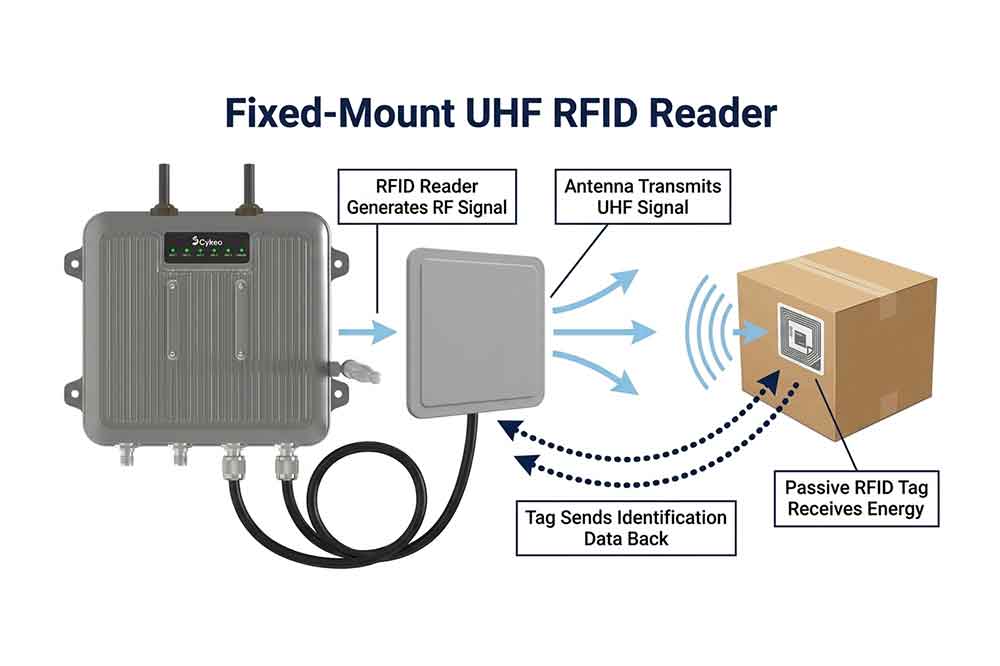
When a compatible passive UHF tag enters the antenna’s coverage area, the tag receives energy from the transmitted signal. Its chip then uses this energy to respond to the reader.
The reader does not need physical contact with the tag. This makes UHF RFID suitable for applications where items move continuously or where several products need to be identified in a short period.
Instead of generating its own radio transmission, the tag changes the way it reflects the reader’s RF signal. The reader detects these changes and decodes the information returned by the tag.
The information may include an Electronic Product Code (EPC), a unique identifier, or other stored data, depending on the tag configuration.
This communication method allows a fixed reader to identify tagged items without requiring a direct line of sight. However, this does not mean that every tag can be read from every position. Metal surfaces, liquids, tag orientation, and surrounding structures can affect RF performance.
Imagine a pallet carrying dozens of tagged cartons. A barcode system generally requires each label to be presented to a scanner individually. A properly configured UHF RFID reader can identify multiple tags during the same reading session.
Anti-collision protocols help organize communication between the reader and multiple tags, reducing the chance of communication conflicts.
The actual reading speed depends on the reader chipset, tag population, antenna configuration, RF environment, and software settings. Therefore, a high tag-reading rate in a datasheet should always be evaluated against the requirements of the actual project.
Important specifications include:
A fixed reader may support one antenna or multiple external antennas. For example, a four-port reader can connect to four antennas, allowing a system designer to establish several reading zones.
Antenna selection should consider:
Using more antennas does not automatically guarantee better identification. Poor antenna positioning can create overlapping reading zones or cause unwanted tags to be detected.
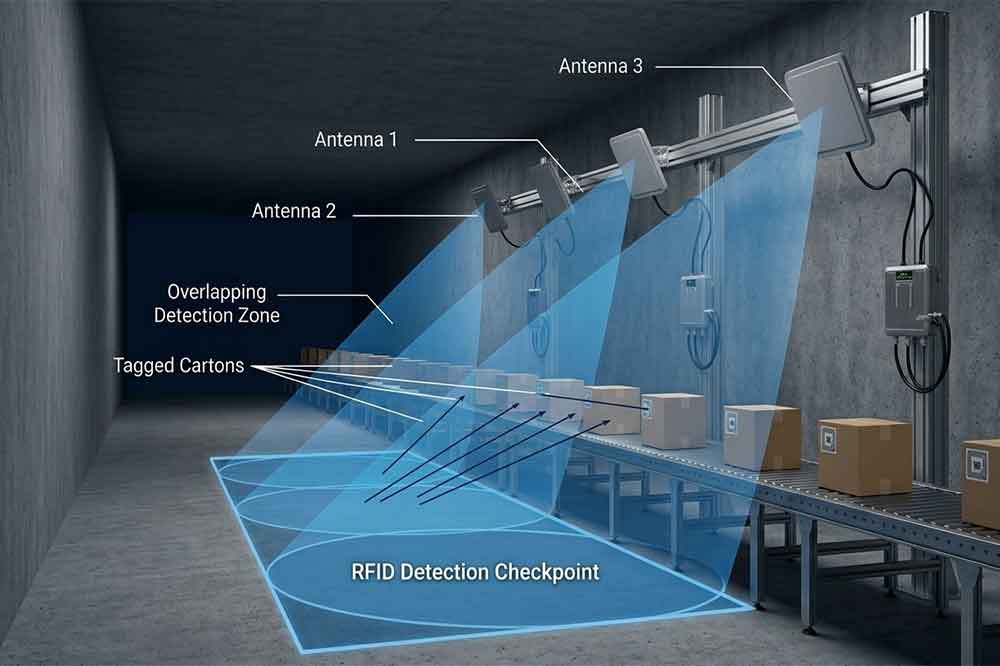
The collected data can be sent to warehouse management software to support receiving, dispatching, and inventory updates.
Fixed readers installed along production lines identify items as they move between processing stations. This helps manufacturers associate each item with the correct production stage.
Instead of checking every item manually, the system can identify which tagged assets are present in a designated area.
When a compatible vehicle tag enters the reading zone, the system can send its identification data to access control software for further verification.
The reader identifies tagged items during storage or retrieval. With appropriately positioned antennas, the equipment can support automatic inventory records without requiring manual item registration.
For example, an automated warehouse project may require readers, antennas, RFID tags, mounting brackets, network communication, and WMS integration. Each component affects the final identification result.
Cykeo provides fixed RFID reader options with four-port, eight-port, and sixteen-port configurations for different industrial applications. The product range includes hardware for warehouse checkpoints, production lines, asset tracking, and automated identification. SDK and API support is also available to assist system developers and integrators. Cykeo
For projects requiring multiple reading zones, the antenna layout should be tested before the installation is finalized. A practical test can reveal whether tags are being missed, whether adjacent zones interfere with each other, and whether the reader is collecting unwanted tag information.
The Cykeo RFID Readers product range provides a starting point for evaluating fixed reader hardware for industrial and OEM applications.
Unlike handheld RFID devices, fixed readers are installed at specific locations and operate as part of a permanent identification system. They can monitor goods moving through a checkpoint, track materials on a production line, or identify assets stored inside a designated area.
However, installing a fixed UHF RFID reader involves more than choosing a device with a long reading distance. Antenna placement, tag selection, radio frequency settings, surrounding materials, and software integration all affect the final result.
Understanding these factors helps system integrators and equipment manufacturers select the right RFID hardware for their projects.
What Is a Fixed-Mount UHF RFID Reader?
A fixed-mount UHF RFID reader is a stationary device that communicates with UHF RFID tags through radio frequency signals. It is normally installed on a wall, mounting bracket, warehouse gate, production machine, or other fixed structure.Most industrial UHF RFID systems use passive tags. These tags do not require an internal battery. Instead, they receive energy from the radio frequency field generated by the reader’s antenna and respond by transmitting their stored identification information.
UHF RFID commonly operates within the 860–960 MHz range, although the exact frequency band depends on regional regulations and equipment configuration. EPC Class 1 Gen 2 and ISO/IEC 18000-63 are widely used communication standards for passive UHF RFID systems. ifm+1
A fixed-mount reader is particularly useful when identification needs to happen repeatedly at the same location. Once installed and configured, it can collect tag information automatically without depending on employees to perform manual scans.
For example, a warehouse can install readers at loading doors. When tagged pallets pass through the reading area, the system identifies them and sends the collected information to warehouse management software.
How Fixed-Mount UHF RFID Readers Work
The communication process between a fixed reader and an RFID tag involves several steps. Understanding this process is important when designing an RFID installation.
UHF Radio Frequency Communication
The reader generates an RF signal and sends it through one or more connected antennas.When a compatible passive UHF tag enters the antenna’s coverage area, the tag receives energy from the transmitted signal. Its chip then uses this energy to respond to the reader.
The reader does not need physical contact with the tag. This makes UHF RFID suitable for applications where items move continuously or where several products need to be identified in a short period.
RFID Tag Identification and Backscatter
Passive UHF RFID communication uses a principle called backscatter.Instead of generating its own radio transmission, the tag changes the way it reflects the reader’s RF signal. The reader detects these changes and decodes the information returned by the tag.
The information may include an Electronic Product Code (EPC), a unique identifier, or other stored data, depending on the tag configuration.
This communication method allows a fixed reader to identify tagged items without requiring a direct line of sight. However, this does not mean that every tag can be read from every position. Metal surfaces, liquids, tag orientation, and surrounding structures can affect RF performance.
Anti-Collision and Multiple Tag Reading
One of the main advantages of UHF RFID is its ability to identify multiple tags within a reading area.Imagine a pallet carrying dozens of tagged cartons. A barcode system generally requires each label to be presented to a scanner individually. A properly configured UHF RFID reader can identify multiple tags during the same reading session.
Anti-collision protocols help organize communication between the reader and multiple tags, reducing the chance of communication conflicts.
The actual reading speed depends on the reader chipset, tag population, antenna configuration, RF environment, and software settings. Therefore, a high tag-reading rate in a datasheet should always be evaluated against the requirements of the actual project.
Main Components of a Fixed-Mount UHF RFID System
A fixed reader is only one part of an RFID installation. Its performance depends on how the other components work together.RFID Reader
The reader controls the communication process between the system and RFID tags.Important specifications include:
- Supported UHF frequency band
- EPC C1G2 / ISO 18000-6C compatibility
- RF output power
- Number of antenna ports
- Tag identification speed
- Communication interfaces
- Supported SDKs and APIs
UHF RFID Antennas
Antennas determine how RF energy is distributed across the reading area.A fixed reader may support one antenna or multiple external antennas. For example, a four-port reader can connect to four antennas, allowing a system designer to establish several reading zones.
Antenna selection should consider:
- Linear or circular polarization
- Antenna gain
- Reading direction
- Installation distance
- Required coverage area
- Surrounding metal structures
Using more antennas does not automatically guarantee better identification. Poor antenna positioning can create overlapping reading zones or cause unwanted tags to be detected.
Common Applications of Fixed-Mount UHF RFID Readers
Fixed-mount UHF RFID readers are used in applications where automatic identification needs to take place at a defined location.Warehouse and Logistics Checkpoints
Readers installed at loading doors or warehouse entrances can identify tagged pallets, cartons, and containers as they move through a checkpoint.The collected data can be sent to warehouse management software to support receiving, dispatching, and inventory updates.
Manufacturing and Production Lines
In manufacturing, RFID tags can be attached to workpieces, production carriers, or reusable containers.Fixed readers installed along production lines identify items as they move between processing stations. This helps manufacturers associate each item with the correct production stage.
Asset Tracking
Factories, hospitals, and equipment management companies may use fixed readers to monitor tagged tools, machines, and reusable assets.Instead of checking every item manually, the system can identify which tagged assets are present in a designated area.
Access Control and Vehicle Identification
Fixed UHF RFID readers can also be installed at vehicle entrances, parking facilities, and industrial access points.When a compatible vehicle tag enters the reading zone, the system can send its identification data to access control software for further verification.
Smart Cabinets and Automated Equipment
Some OEM projects integrate fixed UHF RFID readers into cabinets, lockers, storage equipment, or automated machines.The reader identifies tagged items during storage or retrieval. With appropriately positioned antennas, the equipment can support automatic inventory records without requiring manual item registration.
Fixed-Mount UHF RFID Reader Integration
A fixed UHF RFID reader should be selected as part of the complete identification system, not as an isolated hardware purchase.For example, an automated warehouse project may require readers, antennas, RFID tags, mounting brackets, network communication, and WMS integration. Each component affects the final identification result.
Cykeo provides fixed RFID reader options with four-port, eight-port, and sixteen-port configurations for different industrial applications. The product range includes hardware for warehouse checkpoints, production lines, asset tracking, and automated identification. SDK and API support is also available to assist system developers and integrators. Cykeo
For projects requiring multiple reading zones, the antenna layout should be tested before the installation is finalized. A practical test can reveal whether tags are being missed, whether adjacent zones interfere with each other, and whether the reader is collecting unwanted tag information.
The Cykeo RFID Readers product range provides a starting point for evaluating fixed reader hardware for industrial and OEM applications.